LDS Views on War Articles

LDS Views on War

LDS Views on War

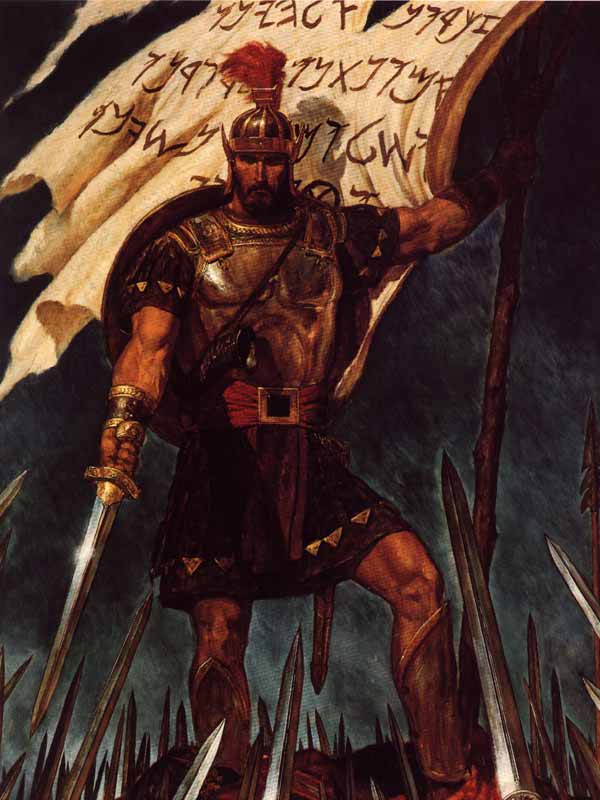
The Church of Jesus Christ of Latter-day Saints looks on war with the greatest abhorrence, and the teachings of the gospel of Jesus Christ tell us that we should sue for peace, forgive those who wrong us, and love our enemies. Nevertheless, there are occassions when even God commands His people to go to war, and prophets have foretold wars and rumors of wars throughout all time, particularly before the Savior comes again. Throughout the Bible and the Book of Mormon God’s people have been commanded to fight to preserve their ”religion, and freedom, and [their] peace, [their] wives, and [their] children” (Alma 46:12). Additionally, the Church proclaims, “We believe in being subject to kings, presidents, rulers, and magistrates, in obeying, honoring, and sustaining the law” (Articles of Faith 1:12), and military service falls under this principle. However, “if Latter-day Saints must go to war, they should go in a spirit... Read the rest of this article »

Servicemen and -Women Speak of Their Love for the People of Iraq and Afghanistan

Servicemen and -Women Speak of Their Love for the People of Iraq and Afghanistan

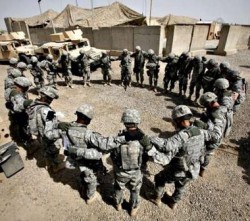
Latter-day Saint men and women serving in the U.S. military today in Iraq and Afghanistan have used their experiences to try and bless the lives of those around them, both in and outside of the service. Here some of them relate the powerful experiences they have and the opportunities they have been given to serve in meaningful, often life-changing ways. These soldiers have discovered that, though they cannot proselyte their beliefs while serving in the armed forces, they can still live the gospel of Jesus Christ bringing love to all those whom they meet. They have been able to share the gospel in its truest form, not by preaching it, but by living its precepts and using its teachings to bless the lives of others. Chief Warrant Officer 2 Jared Kimber relates his experiences of bringing toys to the children of desolate villages. Civilian Mentor to Ministry of Defense and Afghan National Police, Eugene J. Wikle tells of his participation in a service project... Read the rest of this article »

Persistence, Miracles, and Eternal Relationships

Persistence, Miracles, and Eternal Relationships

Prior to being deployed in Afghanistan, I was seriously considering retirement. I had served for many years, and my wife and I felt I had spent enough time away from home. I made the arrangements and handed in my intent-to-retire papers to my commander. He looked at the papers and then at me. Before he could say anything I reached out, took the papers back, and said, “I’ll let you know when you can have that.” For some reason, I knew I still had work to do in the military. I was soon thereafter deployed with my Utah National Guard unit to Afghanistan. Even though I was being sent over as a[n] Apache helicopter pilot, I knew that there was another reason I was going. I knew there was something else for me to accomplish in Afghanistan. After our arrival in Bagram Air Base in north-central Afghanistan, our unit developed a unique relationship with the Egyptian military personnel who ran the Egyptian military hospital on the base. The Egyptian and... Read the rest of this article »

Looking into the Eyes of Prisoners

Looking into the Eyes of Prisoners

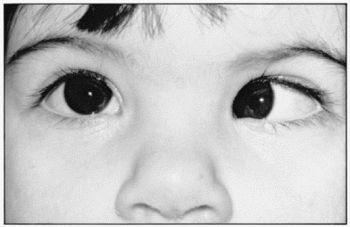
As an optometrist, I had the opportunity to travel around Iraq providing eye care to soldiers, Iraqi civilians, and detainees in prison. I was the only optometrist on our base, so I stayed very busy. One day a medical commander asked me if I would be willing to visit different prisons and examine detainees. He explained that the Red Cross had asked us to provide eye care in the prisons. I said I would go if my commander so directed. He responded, “I know, but are you willing to go?” I agreed to be of assistance to anyone who needed me. Once I agreed, I was told that my patients were going to be HVDs (High Value Detainees)—prisoners of special importance. Some of the eyes I examined belong to those featured on the “Most-wanted Iraqi playing cards.” These cards were issued by the U.S. military to help troops identify the most-wanted members of President Saddam Hussein’s government. To meet with these people and provide them with medical care... Read the rest of this article »

Blankets Warm Victims

Blankets Warm Victims

With less than one month left in my deployment, my aunt and her daughter-in-law organized a girls’ camp project to make twelve blankets for people in need. These large, soft fleece blankets were handmade with loving care and sent to me for distribution. As I thought about who should receive the blankets, I remembered a recent car bombing in downtown Kirkuk. I thought it would be meaningful if we could find victims of the attack and let them know that Americans care and were thinking of them. A friend of mine who served as the provincial police chief went to work and identified several families directly affected by the attack. The location of the families posed a real and dangerous threat. Kirkuk can be an unpredictable, menacing city. This mission was unique because my team was going to rely on the police chief to guide and escort our convoy without us knowing beforehand exactly where our route would take us. We had to trust him. Most of my men were... Read the rest of this article »

The Children Clung to Us

The Children Clung to Us

In May 2006, I had the opportunity to perform a community service project delivering food and toys to an Afghan refugee camp. We began with a convoy briefing and were assigned to one of three convoy teams. The first convoy team was comprised of armed military personnel who would deploy first to establish a security perimeter around the refugee camp prior to our arrival. The refugee camp is located west of Kabul. We departed at 0830 and arrived at the camp at 0900. We had to wear body armor while traveling to and from the camp. When we arrived at the camp, we were allowed to remove our body armor. I was assigned to the second convoy team. Our mission was to deliver toys to the children and play with them while the donated food was delivered to the adult refugees by the third convoy team. Many of the refugees live in a bombed-out multistory building, although some live in tents. They have no electricity. Their water is located outside the building. We... Read the rest of this article »

Delivering Joy in a Blackhawk

Delivering Joy in a Blackhawk

While serving in Kirkuk, Iraq, my living quarters were on the edge of our base. I lived so close to the perimeter that I could see through the wire and watch the Iraqi children on the outside. The children frequently occupied their time by playing games. These kids did not have anything. I never saw them play with any kind of toy. Yet they were able to find joy by playing tag or games of soccer in their bare feet using an old can instead of a ball. My flying partner had children back home, so he was very sensitive to the needs of these kids. Together we watched the children make the best of their situation. One day as the children played, my partner and I walked over to the fence and threw a few toys over the tall barrier. The kids were very excited for the gifts and amazed that anyone would give them toys. We shared with our friends on base what we had done, along with the touching reaction of the children. The word of our experience began to spread.... Read the rest of this article »

If God Is for Us, Who Can Be against Us?

If God Is for Us, Who Can Be against Us?

I first heard of the truth of the restored gospel form Sister Ida Korth in Schwerin, Mecklenburg. During a visit, she told me of the First Vision, the Prophet Joseph Smith and his calling to be a prophet, the Angel Moroni, the Book of Mormon, and the restoration of the true Church of Christ. She told me about the “last days,” in which we are now living, and the necessity for all people to repent. Her words were so lively and convincing that I did not doubt for a moment that these things were true. This was on a cold Sunday in February, and because I was so interested, she invited me to attend a church service that very afternoon. I hesitated for a moment, thinking of another event I wanted to attend, but then I went with her to the church service. It was very cold, and the simple room in the tavern where we held sacrament meeting at that time was not terribly inviting, but the friendliness with which I was welcomed by the members made a great impression... Read the rest of this article »

Accounts of Latter-day Saints in East Germany

Accounts of Latter-day Saints in East Germany

During and after World War II, the Saints in East Germany, and all other occupied or devastated areas, had little-to-no access to Church headquarters. Despite the devastating effects of the war on every aspect of their lives, these Saints remained faithful. They pulled together to strengthen one another. Miracles happened, faith grew stronger, and against all odds, the Saints prevailed and survived. It was very hard for these Saints to communicate with Church headquarters because nearly all communication had been stopped by the occupation. All citizens of the occupied area could no longer travel freely. The literature they were able to distribute and receive was monitored and severely restricted. All other resources were also limited. At times many people were near starvation, they had little clothing, and at times almost no shelter. Many lost their homes in the bombings and work was scarce. Everyone struggled to provide for their families and themselves. In... Read the rest of this article »

Let's Follow Dad—He Holds the Priesthood

Let's Follow Dad—He Holds the Priesthood

February 13, 1945, is an unforgettable day in the lives of thousands of people who were living in Dresden, Germany. World War II was in full fury, with armed forces on all sides pushing towards the German borders trying to send this terrible war. We felt quite safe in our city of Dresden, the “Florence on the Elbe,” with its many cultural, historic, and architectural treasures. Surely no one would try to destroy these. There was no heavy industry in the region, and this late in the war the population consisted primarily of women, children, and the elderly. However, burgeoning numbers of wounded and sick and thousands of refugees arrived daily from the German settlements beyond the Polish border. Even though all the other major cities of Germany had experienced numerous air raids, Dresden had been spared this terrible destruction. It was 10:30 that February night when we first heard the dreadful sounds of the sirens and the roar of hundreds of planes... Read the rest of this article »

Copyright © 2012 More Good Foundation
This website is not owned by or affiliated with The Church of Jesus Christ of Latter-day Saints (sometimes called the Mormon or LDS Church). The views expressed herein do not necessarily represent the position of the Church. The views expressed by individual users are the responsibility of those users and do not necessarily represent the position of the More Good Foundation. For the official Church websites, please visit LDS.org or Mormon.org.