Browse >
Home / Archive by category '
Bios / Past Leader Bios'
Past Leader Bios Articles
When people think of Mormon General Authorities (high level church leaders), they tend to think of dignified men who speak carefully and behave traditionally. Even for his own time, J. Golden Kimball defied tradition. He was nicknamed “The Swearing Apostle” and when church meetings were first broadcast on radio, people worried about his vocabulary. His approaches to problem-solving were often unique for his environment, but he was effective and no one ever questioned his testimony. He attributed his bad habit of swearing—something Mormons generally avoid—to having been a mule driver in his younger days. He said it’s the only language mules understand.
He was initially a reluctant missionary. His mother wanted him to serve, but he didn’t really want to go. In those days, it was easier to find yourself on a mission than it is today. His mother asked him to meet with the prophet about it and he showed up dirty and wearing visible guns and knives... Read the rest of this article »
By Terrie
Sidney Rigdon was an early leader of The Church of Jesus Christ of Latter-day Saints (often misnamed the “Mormon Church”). He was born in 1793 in Pennsylvania. When he was seventeen, his father died. His mother died when he was twenty-six, but the year prior to that, Sidney became a Baptist and left home to become a preacher. Six years later, in 1824, Sidney Rigdon, Alexander Campbell, and Walter Scott left the Baptist church over the issues of what happened to infants who died without baptism and began meeting together to discuss religion. They were known as Campbellites, although they called themselves Disciples. Sidney Rigdon continued his work as a preacher, but focused on faith, repentance, baptism, and the Holy Ghost, rather than promoting the doctrines of a specific religion.
In 1830, The Church of Jesus Christ of Latter-day Saints was organized and its members were largely known as “Mormons.” One Mormon leader, Parley P. Pratt,... Read the rest of this article »
By Terrie
Oliver Cowdery, born 3 October 1806, in Wells, Rutland County, Vermont, played important roles in the early days of The Church of Jesus Christ of Latter-day Saints (frequently misnamed the “Mormon Church”). He moved to western New York along with several of his brothers in hopes of finding better employment opportunities. He became a general store clerk, but also did blacksmithing and farming.
Oliver met Joseph Smith when his brother was unable to take on the school teacher job he had been hired to do. He recommended Oliver for the position, and Oliver was hired by the trustees. The position was near the Smith home and Joseph’s brother Hyrum was a trustee, so he arranged for Oliver to board in his parents’ home.
Joseph was in the process of translating (with the help of his wife, Emma, and her brother, who acted as scribe) the plates that would become the Book of Mormon. However, Joseph also had to work to support his family, and his... Read the rest of this article »
During the period of the extreme and unrelenting prosecutions under the anti-polygamy acts of Congress, President Wilford Woodruff spent much of his time among the churches in Arizona and southern Utah. On January 26, 1880, having retired for some days in the mountains, fasting and praying, he obtained important revelations from the Lord concerning the work of the Twelve Apostles and events which would happen affecting both the Church and the nation. These were submitted to President John Taylor and the Council of the Apostles and were accepted by them as profitable for doctrine, for comfort, for light as to the future, and for encouragement in the work of the ministry. Following is President Woodruff’s account of receiving revelation.
Wilford Woodruff Mormon Prophet
During the month of January, 1880, I was at Sunset, Arizona, with Brother Lot Smith and the brethren with him who were trying to establish a Branch of the United Order at that place.... Read the rest of this article »
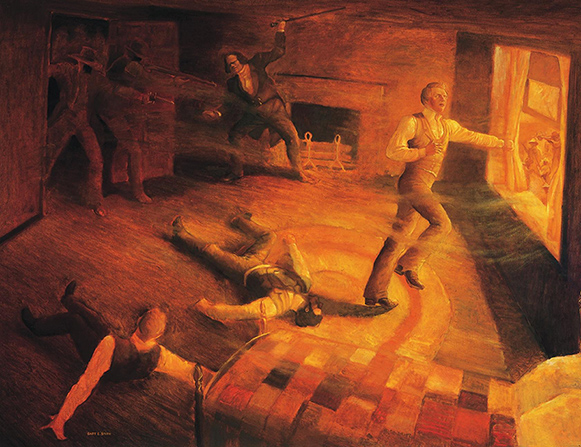
In adulthood, Hyrum Smith was described as being five feet, eleven inches tall and as weighing about 190 pounds. He and Joseph were of similar builds and very much resembled each other physically. They were also completely devoted to each other in the gospel. John Taylor, the third president of the Church, described Hyrum in the following way:
Hyrum Smith
“[He] is a man of sterling integrity, deep penetration and brilliant talents. He is well versed in politics and [is] as unchangeable as the everlasting hills. He is a man of probity and virtue, and an unwavering patriot.” After Hyrum’s death, Taylor said of him, “If ever there was an exemplary, honest and virtuous man, the embodiment of all that is noble in the human form, hyrum Smith was the representative” (Hyrum Smith: A Life of Integrity, Jeffrey S. O’Driscoll, 251).
Being the brother of Joseph Smith, Hyrum often does not receive quite as much recognition now... Read the rest of this article »
A Peacemaker
Hyrum’s mild manner and impeachable character allowed him to serve as a peacemaker even in his own family. At a time when his younger brother William became very upset with Joseph after being rebuked by him, Hyrum tried to bring William around. Joseph recorded that Hyrum “was perfectly satisfied with the course I had taken in rebuking William in his wickedness, but he is wounded to the very soul, because of the conduct of William; and although he experiences the tender feelings of a brother towards him, yet he can but look upon his conduct as an abomination in the sight of God” (Hyrum Smith: A Life of Integrity, Jeffrey S. O’Driscoll, 142). Though it took some time and more hard words from William, the brothers and family as a whole became reconciled. Having kept a cool head, Hyrum was able to bring peace back to the relationship after William acknowledged his faults and returned to the family. In situations regarding... Read the rest of this article »
Parley Parker Pratt was born on April 12, 1807, to Jared and Charity Pratt in Burlington, New York. He married Thankful Halsey on September 9, 1827, and they settled in Cleveland, Ohio. Pratt was a very religious man, and he soon joined a local congregation, where a man named Sidney Rigdon was preacher.
A few years later Pratt was travelling in New York and came across a copy of a religious book that intrigued him so much that he read nearly the entire book in one night. It was the Book of Mormon. Parley recounts his first experience with the Book of Mormon, saying, “I read all day; eating was a burden, I had no desire for food; sleep was a burden when the night came, for I preferred reading to sleep. As I read, the spirit of the Lord was upon me, and I knew and comprehended that the book was true, as plainly and manifestly as a man comprehends and knows that he exists. My joy was now full, as it were, and I rejoiced sufficiently to more than pay... Read the rest of this article »
George Albert Smith
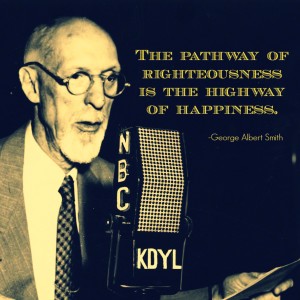
George Albert Smith was born April 4, 1870, in Salt Lake City, Utah, to John Henry and Sarah Farr Smith. President Smith had a noble ancestry, in that his great grandfather was John Smith, brother to Joseph Smith, Sr., who was the first stake president in the Salt Lake Valley and later served as the Patriarch to the Mormon Church. John Smith’s son George Albert Smith was President George Albert Smith’s grandfather and the person for whom he was named. George Albert Smith’s grandfather was also a cousin to the first Mormon prophet, the Prophet Joseph Smith. Throughout his life, President Smith would be known as ‘George A.’
Like all boys born at this time in Utah, George Albert Smith was privileged to watch the construction of the Salt Lake Temple. As a youth, he spent his time herding cows, riding horses, and studying. He was fortunate to be surrounded by strong, worthy servants of the Lord. His grandfather, George... Read the rest of this article »
Heber J. Grant was born November 22, 1856, in Salt Lake City, Utah, to Jedediah M. Grant and Rachel Ivans Grant. Heber’s father died nine days after Heber was born, leaving Rachel to raise her first and only child alone.
Even though Heber never knew his father, his influence would be present throughout his life. President Brigham Young, speaking at Jedediah Grant’s funeral, said the following: “Brother Jedediah had been in the church a total of twenty-five years, but in those twenty-five years he had given the Lord one hundred years of Church service.”
In 1891, Heber asked a president of a bank, a respected man who was not a member of the Mormon Church, to sign some bonds. He promptly refused to do so. Just a few minutes later, he sent a messenger and asked Heber to return. As Heber entered the office, the businessman said: “Young man, give me those bonds.” He signed them and then said, “When you were here a... Read the rest of this article »
John Taylor was born November 1, 1808, to James and Agnes Taylor. Eight sons and two daughters were born to this couple, although three sons did not survive past infancy and another son passed on at the age of twenty-two. These children were blessed with loving and kind parents who taught their children to read and believe in the Bible. John’s belief and trust in Christ carried him throughout his life in that he called upon the Lord often in prayer. His upbringing in the Church of England settled in him a deep devotion and love for God. He remarked that he had always, “…made it a practice to go and call upon the Lord…many a time I have gone into the fields…would bow before the Lord and call upon Him to guide and direct me. And he heard my prayer…that was the spirit that I had when a little boy…my spirit was drawn out after God then; and I feel the same yet.”1
At the age of sixteen, John left the Church of England and joined... Read the rest of this article »