

In the early twentieth century, Mormon missionaries continued to preach in the traditional lands of Europe and throughout America, while still seeking to reach entire new countries in order to fulfill Jesus Christ’s commandment to “teach all nations” (Matthew 28:19). In 1898, the first full-time female Mormon missionaries were called. In 1901, the 21st Mission of the Mormon Church was created in Japan by President Lorenzo Snow. Heber J. Grant, future President of the Mormon Church, led that mission. In the years before World War I, Mormon missionaries began proselytizing in Africa, Finland, Russia, Palestine, and they returned to areas of Europe like France, Greece, and Italy from which they had pulled missionaries during the dark days of persecution in the late nineteenth century.
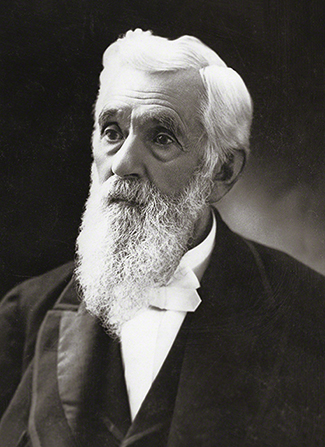
Lorenzo Snow. Courtesy of the LDS Media Library.
Missionary work slowed considerably during World War I, but following the war, Mormon missionaries had great success in Europe, particularly in Germany, where thousands joined the Mormon Church during the 1920’s and 1930’s. In fact, in the interwar period, Germany led the Church in growth. Mormon missionaries also began preaching in Portugal and in Brazil, which has since become one of the strongest areas of Mormon growth. David O. McKay, a Mormon Apostle and future Mormon prophet, traveled to every mission of the Church in the 1920’s and, along the way, dedicated China and other nations preparatory to sending in Mormon missionaries.
In 1925, Melvin J. Ballard, one of the Twelve Apostles, created the South American Mission headquartered in Argentina. He prophesied that, one day, the work in South America would grow tremendously and that millions would join the Church. Today, more than 2,000,000 Mormons live in South America, and it remains the fastest growing region of the world for the Mormon Church.
The number of Mormon missionaries remained fairly consistent throughout the early twentieth century, and the calls to missionary service remained irregular. Not every Mormon was expected to serve a full-time mission, though all were expected to share the Gospel with friends and families in their daily lives and serve in volunteer capacities with their local Mormon congregations. Instead, men or women would be issued calls to go to a certain place for up to three years. Prior to World War II, it was not uncommon for Mormon missionaries to be married.
In the years before World War II, the Mormon missionary force remained at around 5,000 a year, even as, by the 1940s, the Mormon Church’s membership approached 1,000,000. Most Mormons at this time lived in the American West, in the historical band of Mormon settlements that stretched along the Rocky Mountains from Alberta Canada to northern Mexico, though Pancho Villa’s revolt had driven many Mormons out of Mexico and into Arizona. Beginning in the early twentieth century, Mormon leaders began to urge members to remain in their home countries and to build up the Mormon Church in their home lands. This required that temples be built throughout the earth. In the early part of the twentieth century, Mormon temples were built in Hawaii and Canada. The first European temple was built in 1955 in Bern, Switzerland. During World War II, few Mormon missionaries served (only hundreds per year as opposed to thousands). After the war, when David O. McKay became President of the Mormon Church, all that would soon change.
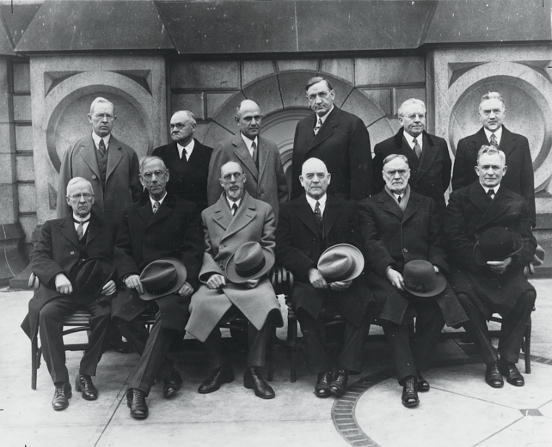
The Quorum of the Twelve Apostles in 1921. Standing, left to right: Joseph Fielding Smith, James E. Talmage, Stephen L Richards, Richard R. Lyman, Melvin J. Ballard, and John A. Widtsoe. Seated, left to right: Rudger Clawson, Reed Smoot, George Albert Smith, George F. Richards, Orson F. Whitney, and David O. McKay. Both Melvin J. Ballard and David O. McKay helped the Church make great strides in missionary work. Courtesy of the LDS Media Library.
Today, missionaries continue to serve by preaching the gospel, but they also offer service in the communities where they serve. The catastrophic earthquake and tsunami in Japan in March 2011 caused such extensive damage that it will take years to repair everything. Mormon news shows that missionaries have helped in this clean-up effort. The Church continues to encourage its members to support humanitarian endeavors as part of its goal to bring people to an understanding of God’s love for them.
On to Every Mormon a Missionary
 About Anita Stansfield
Anita Stansfield began writing at the age of sixteen, and her first novel was published sixteen years later. For more than fifteen years she has been the number-one best-selling author of women’s fiction in the LDS market. Her novels range from historical to contemporary and cover a wide gamut of social and emotional issues that explore the human experience through memorable characters and unpredictable plots. She has received many awards, including a special award for pioneering new ground in LDS fiction, the Lifetime Achievement Award from the Whitney Academy for LDS Literature, and also a Lifetime Achievement Award from her publisher, Covenant Communications. She has fifty-six published books. Anita is the mother of five, and has three grandchildren.
 Watch a video about the restoration of the gospel on lds.org