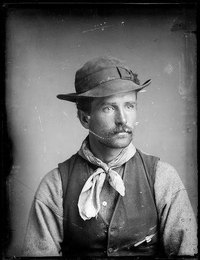
George Edward Anderson, Photographer
Filed under Personal Accounts
George Edward Anderson was a bishop of The Church of Jesus Christ of Latter-day Saints (commonly called the Mormon Church) for four years in the early days of Utah.The legacy he left behind is one of more than 14,000 photographic images of life in the West from the 1870s through the early 1900s. His pictures include people in Utah, Canada, and England (where he served his mission for the church), but the negatives for his Canada and England trips are missing and perhaps lost.
Anderson had a wonderful eye for capturing detail as well as oddities. He was present at a time when the railroad was booming and changing life for the Saints in Utah. Trains are present either in the foreground or the background of many of his images. This was a time when Utah was still largely separated from the rest of the country, but that separation was growing ever smaller.
Anderson’s images included a lot of studio portraits, as well as images which were shot of people in front of their homes or businesses. This characteristic is what makes his work so valuable as a documentation of the history of Utah. He took pictures all over the state, and captured much of the Saints’ experiences in building new communities and settlements. Anderson’s living was mostly made up of the private portraits he took.
Many of Anderson’s images are very touching, including the many images he took after a mining accident in Scofield, Utah, in 1900. His images capture much of the history of this state, including “its piety, its immigration, its stewardship and husbandry . . . [the people's] grieving, a desert agriculture that strove to create abundance out of desolation, and the West” (“Frontier Utah As Seen By Mormon Bishop, Documentary Photographer,” by Richard Remsberg).
George Anderson died in 1928. As many artists, he was largely unknown during his lifetime. His collection included more than 15,000 glass plate negatives, many of which have survived after passing through several private collections. Many of these are now in repositories, with most of them at the L. Tom Perry Special Collections of the Brigham Young University Harold B. Lee Library. The BYU library has many of these pictures in an online archive.
Fasting
Filed under Mormon Beliefs
The principle of fasting is an ancient one, which is outlined a good deal in the fifty-eighth chapter of Isaiah and briefly in the third chapter of Malachi. In these scriptures, the Lord defines the law of the fast and lists specific blessings which come from obeying this law. To fast is to go without food or to eat sparingly. For members of The Church of Jesus Christ of Latter-day Saints (which church is often misnamed the Mormon Church in the media), fasting means to go without food or liquid for a twenty-four-hour period, or to skip two full meals. One Sunday each month—generally the first Sunday—is set aside as a Fast Sunday for all Church members. On this day, all those who wish to participate in the fast do so. The reasons behind this practice are outlined below.
Purpose
The Lord declares in Isaiah that the purpose of the fast He has declared is to “loose the bands of wickedness,” to “undo the heavy burdens,” and to “let the oppressed go free.” In modern terms, fasting can free one from temptation, can bring solace in trial, and can bring freedom from oppression. One might logically ask how abstaining from food could bring these things. The answer is that fasting is a much more spiritual than temporal experience when practiced properly. Fasting can remind one of one’s physical weakness and consequent dependence on the Lord. By focusing on this dependence, one can draw closer to the Lord and therefore gain spiritual strength.
Practice
The law of the fast requires much more than simply going without food, and is fulfilled by dealing one’s bread to the hungry, bringing those who are cast out to one’s own home, and clothing the naked, as Isaiah taught. In practice today, Church members are asked to take the money that would have been spent on their two meals and donate it to the poor within their Church’s congregation. These donations are called fast offerings. Members are asked to be as generous as they can afford to be in their fast offerings and often give more than the two meals would cost. These donations are given to the bishop to be distributed at his discretion to those worthy members who stand in need at that time. Fast offerings are different from tithing, which is a payment of 10 percent of one’s increase to the Church. Tithing funds are all sent to Church headquarters, but fast offerings stay within the bounds of one’s own congregation.
Blessings
The blessings which come from paying fast offerings are innumerable, but the Lord outlined some specific blessings in the scriptures mentioned above. The Lord has promised that when individuals pay fast offerings, they will be entitled to good health and to the protection of the Lord. In addition, they are promised that they will receive great light and will leave the darkness surrounding them. The Lord even promises to “rebuke the devourer” for those who are faithful in this commandment. All those who have lived this commandment can testify of additional, personalized, blessings which have come to them through their faithfulness.
Fasting and Prayer
In the New Testament, the Savior spoke many times about the power of prayer and fasting. For example, in Matthew 17, the Savior cast out a devil from a man. When his disciples asked why they had been unable to cast out the devil, the Savior told them it could only be done through “prayer and fasting” (Matt. 17:21). This teaching shows the strength that can be given to those who are already righteous, but who seek more strength through God. Fasting can bring many blessings and has more purposes than helping to feed the poor, though that is one of the noblest services which we can provide. Fasting can be both an expression of faith and an increaser of faith. Special fasts are often held for individuals who have physical trials, such as sickness. Individual fasting can bring personal revelation, can help us gain stronger testimonies of the gospel, can give us strength to withstand temptation, and can help us humble ourselves.