Browse >
Home / Archive by category '
Bios / Interesting Church Members'
Interesting Church Members Articles
Meridian Magazine tells the unusual story of a missionary serving in Europe just after World War II, as Mormon missionary work was beginning to ramp back up. It should be noted this is in no way typical of missionary service and would have been allowed only if the missionary’s leader, known as a mission president, felt inspired to alter the usual rules for missionary work. In this case, although the missionary did unusual things, he was able to share his faith with people who might not otherwise have paid any attention to a Mormon missionary.
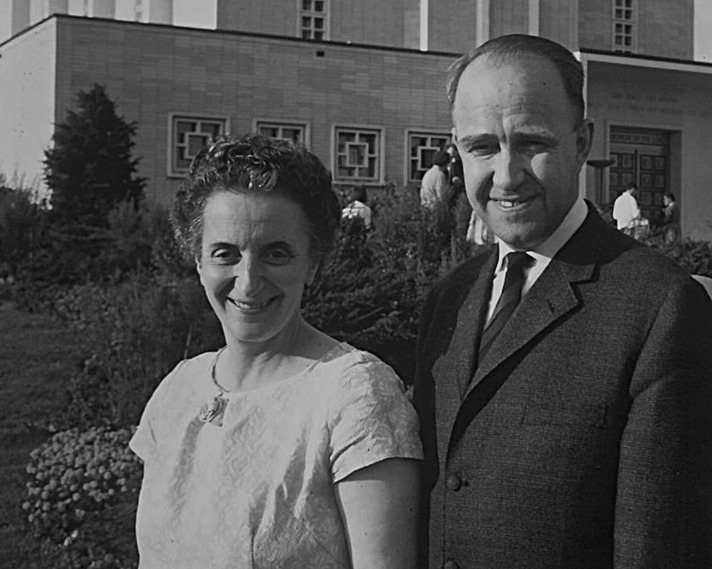
Carl J. Christensen was called to serve a mission in France. He and nine other new missionaries left for Europe by ship. While on the ship, Paul W. Litchfield, Chairman of the Board for Goodyear spotted them and complimented their behavior and dress. He knew many Mormons through his work with the Boy Scouts of America and was a regular listener of the Mormon Tabernacle Choir’s Sunday program, Music and the Spoken... Read the rest of this article »
Cyrus E. Dallin was a noted sculptor born in Springdale, Utah in 1861. He was a member of The Church of Jesus Christ of Latter-day Saints, whose members are often called Mormons. Growing up, he frequently played with the Native American children nearby, setting the stage for a career in which his most noted works were often of Native Americans. He and his Native American friends often sculpted animals from the clay, sparking his interest in sculpture.
While doing odd jobs at his father’s mine, he took some discovered white clay and sculpted it. These creations were shown to many and two patrons decided to pay for his journey to go east to study. His traveling companions were a group of Crow Indians. He was eighteen when he made that trip. He then moved to Paris about ten years later. There he studied sculpture at the Ecole des Beaux Arts and at Academie Julien under Henri Chapu.
In 1883, he won a contract to create a statue of Paul Revere to be placed... Read the rest of this article »
Carl Christian Anton Christensen (better known as C.C.A. Christensen) was born in Copenhagen, Denmark on November 28, 1831. He trained as an artist at the Royal Academy of Art in Copenhagen. The style he learned was realistic and gritty. Students were encouraged to paint images of Danish life to remind the people they were not German and to resist Germanic influences.
Christensen joined The Church of Jesus Christ of Latter-day Saints (still frequently misnamed the Mormon Church) on September 26, 1850. He served missions in Denmark and in Norway for The Church of Jesus Christ of Latter-day Saints. In Norway, Christensen baptized a man by the name of Danquart Anthon Weggeland, who was also an artist. The two later collaborated on several religious artistic works in Utah.
Upon joining the “Mormon Church,” C.C.A. Christensen became a Mormon artist, though not full time. He took his training of capturing Danish life and applied it to capturing Mormon life... Read the rest of this article »
John Rowe Moyle was a stonecutter from Plymouth, England. He sailed to the United States in 1856, after his conversion to The Church of Jesus Christ of Latter-day Saints. Upon arriving by rail in Iowa City, he discovered there were no more covered wagons to be purchased for the trek to Salt Lake Valley, so he purchased a handcart and walked with his family, pulling what few possessions they could bring along. After completing the arduous, dangerous journey, he settled in what later became Alpine, Utah.
John Moyle was later called to work on the Salt Lake Temple, utilizing his skills as a stonemason. He walked 22 miles one way each week to work on the temple, returning home to work on his farm before starting all over again. After losing his leg, he continued to walk on a wooden leg, determined to fulfill the work he was called of God to do.
Read More →
John Tanner was a man of great faith. His faith was great enough to miraculously heal a diseased leg. It was also great enough to sacrifice all he was asked to sacrifice to help build the kingdom of God on the earth. Watch this short video of his story.
Treasure in Heaven, Part 1
Treasure in Heaven, Part 2
Read More →
The Helmuth Hübener Group has become somewhat famous in Mormon culture as a group of teenage boys who took it upon themselves to resist the Nazi regime. While they did do this, a personal account from the last-surviving member of the group, Karl-Heinz Schnibbe, brings to light the heroism as well as the innocence and naivety of these boys as well as the price each of them paid.
Helmuth Huebener
Schnibbe recalls how the rise of the Nazi regime was viewed by most as a good thing in the beginning. Though not everyone liked them, they did vastly improve the economy and morale of the country. Growing up in Hamburg, Schnibbe was aware of the intense, of later hidden, dislike of the new regime. However, along with this, Schnibbe remembers how the regime went after the youth immediately, filling them with propaganda and having them do military drills, though the children did not all realize at the time what was going on.
Karl-Heinz credits his father’s... Read the rest of this article »