Personal Recollection of Joseph Smith’s Integrity and Kindness
Filed under Personal Accounts
Mark L. McConkie, a professor at the University of Colorado, has recently published a book entitled Remembering Joseph: Personal Recollections of Those Who Knew the Prophet Joseph Smith. Below is an excerpt from this book, a recollection of Mary Adams, regarding a specific incidence of Joseph’s kindness while he upheld his position of authority in the town over which he was mayor.
While he [Joseph Smith] was acting as mayor of the city, a colored man called Anthony was arrested for selling liquor on Sunday, contrary to law. He pleaded that the reason he had done so was that he might raise the money to purchase the freedom of a dear child held as a slave in a southern state. He had been able to purchase the liberty of himself and wife and now wished to bring his little child to their new home. Joseph said, “I am sorry, Anthony, but the law must be observed, and we will have to impose a fine.”
The next day Brother Joseph presented Anthony with a fine horse, directing him to sell it, and use the money obtained for the purchase of the child.
Sister Adams says how well she remembers the feeling of sorrow that pervaded the city, when the two brothers were lying dead in the Mansion House. She with the rest of the children, were not permitted to go in the streets owing to the crowd of people who thronged the city, coming and going by steamboat and carriages, and all with grieving hearts for the departed loved ones.
Mary Frost Adams, “Joseph Smith, the Prophet,” Young Woman’s Journal 17, no. 12 (December 1906): 538.
Mary Adams was touched by this kindness from Joseph Smith. I am impressed by Joseph’s ability to handle the situation so well. How his heart must have been broken at the thought of a man who had escaped the wicked bonds of slavery doing all in his power to bring his family back together. Yet, Joseph’s position as mayor required him to exercise the law. Since Anthony had broken the law, Joseph could not ignore the fact, even though his motive was noble. While making sure Anthony answered for the law he had broken, Joseph reached out in love and mercy to offer this man the chance to reunite his family in freedom.
While slavery remains inexcusable, as does prejudice, the fact remains that at the time Joseph did this, African Americans were not generally looked on as equals to other races. I believe that Joseph recognized the equal value of all members of the human race, without regard to gender, religion, or ethnicity, but having that attitude during the time in which he lived is even more testament to the remarkably honest and righteous man he was.
This article was written by Doris White, a member of The Church of Jesus Christ of Latter-day Saints.
Additional Resources:
Joseph Smith: Prophet of the Restoration
The Book of Mormon (Another Testament of Jesus Christ)
The Lord Jesus Christ in Mormonism
Visiting the Sacred Grove
Filed under Mormon Historical Sites
On a June day in 2012, my husband and I pulled in to Palmyra, New York. I had wanted to go to the Sacred Grove for years, and I was excited about the opportunity that had finally come to visit it and many other historical sites of The Church of Jesus Christ of Latter-day Saints (which church is often misnamed the “Mormon Church”). It was pretty early in the morning that day, so we were lucky enough to have the place to ourselves for a little bit.
We walked by the Smith Family Home and back into the trees to take advantage of the fact that we were alone. As we quietly walked through the grove of beautiful trees, I thought to myself, “Heavenly Father and Jesus Christ appeared here!” Just that thought filled me with a sense of awe and reverence. I have been in holy places before, but this was a wonderful and unique experience.
I was born to parents who are both faithful members of The Church of Jesus Christ of Latter-day Saints and, I was raised in the teachings of the Church. I have heard the story of the First Vision all my life, but being in the place where it actually occurred strengthened my personal witness of its veracity.
Joseph Smith, as a young man of 14, struggled with the turmoil that surrounded him in upstate New York in 1820. He was a religious boy who took spiritual matters very seriously, and he was confused by the bickering among different Christian denominations, each claiming to be the only church that had the truth. He wanted to make sure he joined the right church. After studying James 1:5 of the King James Version of the Bible, he was prompted to ask God, in prayer, to help him to know which church was right. Joseph had faith that if he asked God in faith, then he would be given an answer.
On a spring day in 1820, Joseph got up very early and took a walk to be by himself. He walked into the grove of trees behind his family’s home and eventually knelt to pray. The experience he had there was far beyond his imaginings and started a chain of events that is still in motion and cannot be stopped. In answer to a young boy’s prayer, God the Father and His Son, Jesus Christ, appeared in that grove of trees and spoke to Joseph Smith face to face. They told Joseph that none of the churches on the earth at that time contained the fulness of the gospel of Jesus Christ, so he should not join any of them.
Some marvelous truths were restored to the earth just by that visit: God the Father and Jesus Christ were separate beings with tangible bodies; they knew Joseph personally and cared about him, just as they do each one of us; and the fulness of the gospel had been lost from the earth. It was three more years before Joseph received another heavenly visitor who brought instructions from God and Jesus Christ. For several more years, Joseph was taught and prepared to fulfill his calling of restoring the truths that had been lost from the earth.
The Church of Jesus Christ of Latter-day Saints is the only true church on the earth today. This does not mean that no other church has worth or truth. There are many good people and churches who are devoted to bringing people closer to Jesus Christ. However, Jesus Christ Himself has restored the fulness of His gospel and has declared to the world that it is contained in The Church of Jesus Christ of Latter-day Saints.
I know that I am literally a child of a loving Heavenly Father who knows and loves me. I know that Jesus Christ is His only begotten Son in the flesh and that the power of His Atonement gives me and all men and women the ability to repent and be cleansed from sin so that I may someday return to God and remain in His presence forever.
These truths were restored in a beautiful grove of trees in New York nearly 200 years ago. I have felt the influence of these truths in my life, and I felt a peaceful witness in that grove of trees that Joseph saw there what he said he saw. He knew it, he knew that God knew it, and I know that is true.
This article was written by Doris White, a member of The Church of Jesus Christ of Latter-day Saints.
Additional Resources:
Joseph Smith: Prophet of the Restoration
The Book of Mormon (Another Testament of Jesus Christ)
The Lord Jesus Christ in Mormonism
God’s Designs Cannot Be Frustrated: Section 3
Filed under Voice of Christ
Before reading Section 3 of the Doctrine and Covenants, it is important to understand the situation Joseph Smith was in when he received these words from the Lord. It had been less than a year earlier that the angel Moroni had been instructed by the Lord to give the plates to Joseph to translate. Since the morning of September 22, 1827, when Joseph first received the plates, he had protected the plates from thieves and had begun translation that December. Joseph spent December through February 1828 learning how to translate and copying many of the characters. Finally, in February, Martin Harris arrived to work as a scribe for Joseph and the real translation began. Already, Joseph had devoted a great deal to this work. His life had been put in danger many times, but always the Lord protected him.
By June 14, 1828, Joseph and Martin’s work had produced 116 pages of manuscript, and Martin asked Joseph for permission to show the pages to his wife and some of his acquaintances, convinced that if they could see the outcome of the work, they would be convinced of the truth of the work and of Joseph’s calling from God to be a prophet. Not only had Martin Harris devoted a great deal of time to helping Joseph, he had also given Joseph a great deal of money to help him pay off past debts, giving him more free time to work on the translation. Martin was also willing to pay for the publication of the Book of Mormon, which Joseph simply did not have the funds to do himself. Martin Harris was several years Joseph Smith’s senior. It is not difficult to imagine the gratitude Joseph felt for Martin’s help and the obligation he must have felt for all Martin had done for him.
Joseph went to the Lord to seek permission to give the pages to Martin. The Lord told him no. Under considerable pressure, Joseph asked again for permission. Again the answer was no. Joseph was under a great deal of strain when Martin would not accept the answer. Joseph asked of the Lord a third time for permission and was finally told that Martin could take the pages under a condition: he could only show the manuscript to his wife, his brother, his father and mother, and his sister-in-law. Martin agreed to the condition and took the only copy of the manuscript.
Two weeks passed without word from Martin. Joseph finally went after him. Martin, in despair, confessed to Joseph that he had broken the condition the Lord gave him and showed the manuscript to other people. Though he had searched high and low for the pages, they were gone. The anguish Joseph felt is clear from the record of their meeting:
Joseph said, “Martin, have you lost that manuscript? Have you broken your oath, and brought down condemnation upon my head as well as your own?”
“Yes; it is gone,” replied Martin, “and I know not where.”
“All is lost! all is lost! What shall I do? I have sinned—it is I who tempted the wrath of God. I should have been satisfied with the first answer which I received from the Lord; for he told me that it was not safe to let the writing go out of my possession” (Church History in the Fulness of Times, p48).
The Lord told Joseph that evil men had stolen the pages with the design of proving Joseph a false prophet. If he re-translated the record those 116 pages came from, those men planned to make changes to the original manuscript, “proving” that Joseph was not what he claimed to be. Thus, that record was never re-translated.
After returning home, the angel Moroni again appeared to Joseph and told him he must take the plates and tools of translation away from him for awhile, but that he could receive them again if he repented. During this period, Joseph received the revelation that is now Section 3 of the Doctrine and Covenants. The things which the Lord shares with Joseph in this section, when the history of events is understood, bring a good deal of understanding to those who read them.
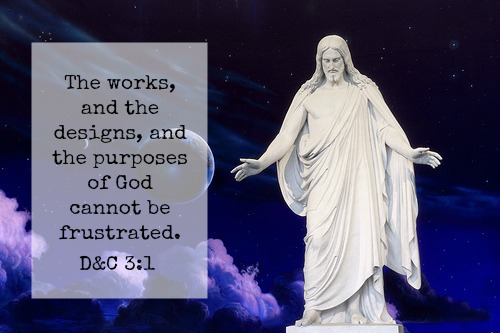
First, the Lord assures Joseph that “The works, and the designs, and the purposes of God cannot be frustrated, neither can they come to naught” (D&C 3:1). If I had been in Joseph’s place at this time, I would have found a great deal of comfort in these words, knowing that, even though I had made a huge mistake, ultimately, no one can defeat the will of God.
The Lord goes on to chastise Joseph even further than he had already been chastised:
Behold, you have been entrusted with these things, but how strict were your commandments; and remember also the promises which were made to you, if you did not transgress them.
And behold, how oft you have transgressed the commandments and the laws of God, and have gone on in the persuasions of men.
For, behold, you should not have feared man more than God (D&C 3:5–7).
Though Joseph must have felt at an all-time low after receiving these words, he is also promised that, if he repents and remains faithful, the Lord will support him against “all the fiery darts of the adversary” (D&C 3:8).
Reading these words, I am filled with a great deal of humility and comfort. I know the Lord has a work for me to do. Surely it is not as great as the work that Joseph Smith was called to do, but in its own way, our works hold the same amount of responsibility for us individually as Joseph’s did for him. Knowing that Joseph was able to repent of such a huge mistake and press forward in the work God had for him gives me hope and peace that I can also overcome my own obstacles and weaknesses.
I am grateful to know that Joseph Smith was a true prophet of God. The truths of the gospel of Jesus Christ which were restored through Joseph Smith by the hand of God bring all of the necessary ordinances back to the earth which are necessary for the salvation of men. The Church of Jesus Christ of Latter-day Saints is the restored church of Jesus Christ and is led by a living prophet today. What a blessing that God still speaks to His children now, when they need more than ever to hear His voice.
This article was written by Doris White, a member of The Church of Jesus Christ of Latter-day Saints.
Additional Resources:
Joseph Smith: Prophet of the Restoration
Request a free copy of The Book of Mormon (Another Testament of Jesus Christ)
A Close Friend’s Impressions of the Prophet Joseph Smith
Filed under Personal Accounts
A recent publication by Mark L. McConkie, Remembering Joseph: Personal Recollections of Those Who Knew the Prophet Joseph Smith, is a wonderful collection of memories and impressions of the remarkable man Joseph Smith was. Below is a personal account from William Taylor about time he spent with the Prophet.
Late in the night the Prophet had gone to my brother John’s house in Nauvoo and said to him: “I want you to go with me to your father’s.” My brother said: “But I can’t go, Brother Joseph; I am sick in bed!” The Prophet replied: “I’ll come in and help you dress, and you’ll find no inconvenience from going out.”
So Brother John got up, dressed and started out with him, and by the time they reached our home, none of us could tell that he had been the least sick. The four stayed at our house a few days and then the Prophet sent the other three back to Nauvoo to see if anything was going wrong at that place. In a few days they returned. During their absence the Prophet and I spent most of our time during the day in the woods, near our house on the Henderson bottom, walking around, shooting squirrels sometimes, or doing anything we could to amuse ourselves. I was the Prophet’s only companion in these tramps through the woods, and I have often thought it strange, that though there were many people in that part of the country we never met anyone when we were out.
It is interesting to see the faith that John had in the Prophet’s words. It may have just beent he prospect of so much intimate time with Joseph that got John going, and he was certainly blessed for going along—not just because his health improved, but also because he strengthened a friendship and gained more knowledge of the gospel. William went on to say:
I do not remember exactly how long the Prophet remained at our home, but it seems to me it was about two weeks, but in this short period, owing to the nature of the circumstances surrounding us, I had more real close association with him than I would have had in a lifetime under different conditions. It is impossible for me to express my feelings in regard to this period of my life.
I have never known the same joy and satisfaction in the companionship of any other person, man or woman, that I felt with him, the man who had conversed with the Almighty. He was always the most companionable and lovable of men—cheerful and jovial! Sometimes on our return home in the evening after we had been tramping around in the woods, he would call out: “Here, mother, come David and Jonathan.”
Much has been said of his geniality and personal magnetism. I was a witness of this—people, old or young, loved him and trusted him instinctively. I said to him once: “Brother Joseph, don’t you get frightened when all those hounding wolves are after you?”
And he answered: “No, I am not afraid; the Lord said he would protect me, and I have full confidence in His word.” I knew the danger, and whatever happened to him would happen to me, but I felt no more fear than I now feel. There was something superior to thoughts of personal safety. Life or death was a matter of indifference to me while I was the companion of the Lord’s anointed!
He said to me often: “I’ll never forsake you, William,” and I knew he wouldn’t.
(William Taylor, “Joseph Smith, the Prophet,” Young Woman’s Journal 17, no. 12 [December 1906]: 547–48.)
What a testimony of a good man. All who met and spent time with the Prophet testified of his love for those around him, his genial attitude, and his kind heart. Having the spirit of Christ with you as much as Joseph Smith did means that you radiate joy and light, and people are drawn to that because they long for it in their own lives as well. Joseph Smith was a true follower of Christ, and his mission was to bring the joy of the Light of Christ into as many other lives as would accept it.
Joseph had more reason than most to fear his enemies. They were relentless and sped on by the hatred of the Adversary who knew what a threat Joseph Smith posed. However, Joseph and been promised by the Lord that he would be protected, and he had complete faith in that promise, as well as all the other promises the Lord made him. This nearness to the Lord dispelled all fear. As William said, “There was something superior to thoughts of personal safety” in Joseph’s company—death became a matter of indifference because not only had Joseph been promised protection until his purpose had been fulfilled, but also, death held no fear for Joseph because he kept the Lord’s commandments.
We can have the same peace and joy that Joseph Smith had and which William felt emanating from Joseph. If we live our lives in accordance with the gospel of Jesus Christ, we can feel of His love for us and feel at peace even in a troubled world.
This article was written by Doris White, a member of The Church of Jesus Christ of latter-day Saints.
Additional Resources:
Joseph Smith: Prophet of the Restoration
Basic Mormon Beliefs and Real Mormons
Jesse Crosby’s Personal Reflection on Joseph Smith
Filed under Personal Accounts
Mark L. McConkie, a professor in the school of public affairs at the University of Colorado, has recently published Remembering Joseph: Personal Recollections of Those Who Knew the Prophet Joseph Smith. This is an excerpt from that book and is the recollection of Jesse W. Crosby.
Brother Jesse W. Crosby, a prominent man in early Dixie and an early preacher of the Gospel lived a close neighbor to the Prophet [Joseph Smith] in Nauvoo. Being a very observing man he learned much of that great man’s home life, and he used to tell us many interesting things about it.
He said the Prophet had great ability as a financier, and that had his enemies left him he would have become one of the wealthiest men in America. Everything his hand touched seemed to prosper. His fields were always in good condition and yielded well.
When people came to see him, and he had many visitors, their teams were fed the best of hay and his barn was full. No other orchard had as fine fruit as his did. If an inferior cow was by any means shoved on to him it would be but a short time before she became a first-class milker. Many men sought his advice when in financial difficulty, and none failed to profit by it if they followed the counsel he gave.
A period of great prosperity for him, Brother Crosby said, would seem to induce a raid upon him. One trial after another would be launched until he was left penniless and perhaps in debt. On one of these occasions when the Prophet had been absent from home for some time, Brother Crosby went to his home to see if he might render some assistance.
When he made the purpose of his visit known, the [Prophet’s] wife burst into tears and said that if the persecution would cease they could live as well as any other family in the land. They could even have the luxuries of life. Bro. Crosby related the following items of interest concerning the Prophet.
He was strong and active, and could build more rods of good fence in one day than most men could do in two, and he always left his fence clear of everything that might gather fire, such as underbrush, loose limbs, and tall strong weeds.
He was orderly. His wood yard was an example of order. Logs were neatly piled and all trash cleared away. If he did not finish the log on which he was chopping the remnant was laid back on the pile and not left on the ground for a stumbling block. The chips he made he picked up himself into a basket and put them in a wooden box which stood in the wood yard to carry them into the house to be burned.
Bro. Crosby confessed this: During a period of financial depression for the prophet, the ax was stolen from his wood yard and Brother Crosby contributed to loan him the ax belonging to himself because of the unfailing habit of the Prophet to always sharpen the ax he had been using before it left his hand. People in that section burned hard wood and to keep the ax in good shape required much time and energy. Some of the home habits of this best friend, however, such as building kitchen fires, carrying out ashes, carrying in wood and water, assisting in the care of the children, etc. were not in accord with Brother Crosby’s idea of a great man’s duty.
(“LaFayette C. Lee, Notebook,” LDS Church Archives, Salt Lake City, Utah.)
What a wonderful personal character sketch of the Prophet Joseph Smith. It is truly the day-to-day activities and actions of a man that show his true character. The commentary regarding how everything Joseph touched seemed to prosper reminds me of Jacob in the Old Testament, when he was working for Laban and was able to build up quite a stock of goods for himself because the Lord blessed him (Genesis 30).
Joseph Smith was a hard and honest worker. He wanted to help those around him, but his enemies refused to leave him alone. Yet, each time Joseph’s enemies thought they had ruined him, he rose like a phoenix from the ashes and prospered again. Even when Joseph willingly went to Carthage and knew it was to his death, he was comforted by the knowledge that he had fulfilled God’s work for him on the earth. How many of us, when we feel our mortality, can say with an honest heart that we know we have done our best to keep God’s commandments and to fulfil His wishes for us here?
Joseph Smith was truly a prophet of God, and he lived his life the best way he knew how to please God.
This article was written by Doris White, a member of The Church of Jesus Christ of Latter-day Saints.
Additional Resources:
Joseph Smith: Prophet of the Restoration
The Book of Mormon (Another Testament of Jesus Christ)
Pieter Vlam, Mormon Missionary under Fire
Pieter Vlam was born on July 8, 1894, to Arien and Aaltje Klant Vlam in the Netherlands. When he was 16 years old, he and his mother and brothers joined The Church of Jesus Christ of Latter-day Saints (which church is often misnamed the Mormon Church). A year after his baptism, Pieter joined the Royal Dutch Navy, where he spent his career. He married Hanna Melaine Gysler on August 24, 1929, in Zurich, Switzerland. Hanna was also a member of the “Mormon Church.”
In 1933, Hanna joined her husband for his tour of duty in Indonesia with their three-year-old daughter, Grace, and their new son, Heber. They stayed in Indonesia until his tour ended in 1938. While the children had been very happy in Indonesia, Pieter was severely persecuted in his career for his religious beliefs, and his superior officer made it impossible for Pieter to extend his stay in Indonesia, so they returned to the Netherlands.
Pieter and Hanna’s plan was always to move to the United States, as soon as it became possible, but this option did not arise for several years. On their way back to the Netherlands, however, the Vlam family was able to stop in Salt Lake City, Utah, and they were sealed together as an eternal family in the Salt Lake Mormon Temple. At this time, the Vlams had another child, Vera. On June 9, 1938, they were sealed together before returning to the Netherlands. In 1939, they had their last child, Alvin.
As World War II approached and the Nazi threat intensified, The Church of Jesus Christ of Latter-day Saints recalled their missionaries from Europe. Vlam was still an officer in the Royal Dutch navy, and he was also called by Elder Joseph Fielding Smith to serve in the Dutch Mission presidency. These men became responsible for the church in their area during the war. In 1940, the Nazis invaded the Netherlands, and Vlam had to move to Voorburg, near The Hague, to find a new job to support his family. Most of Pieter’s neighbors in the area were also former military personnel, but they were standoffish towards their Mormon neighbor. However, after Vera was killed in a tragic train accident at the age of 4, the neighbors’ hearts were softened and they were more open with the Vlam family. The family was struck by the loss of Vera, but they were comforted by the blessings they had received in the temple to be an eternal family.
In May 1942, the former Dutch military were all taken prisoners, including Pieter. Grace was eleven at the time and heard the news at school. She rushed home to find her father gone. She was devastated, but remembers the Spirit telling her audibly that she would see her father again. Pieter was taken to the Nuremberg-Langwasser prison camp. He wrote home asking for a copy of the Book of Mormon and the Doctrine and Covenants. In his letter, his faith was apparent as he said to his wife: “God will bring us together again. . . . We trust in him. Live the gospel with the children. . . . Be courageous and continue a normal life.”
Three months after arriving at Nuremberg-Langwasser, Pieter was transferred to Stanislau, Poland (now Ivano Frankivsk, Ukraine), to Stalag 371, a prison camp in an 18th-century monastery now surrounded by barbed-wire fences. Faced with such a bleak outlook, many of the inmates (some of whom were Pieter’s fellow officers) began asking serious questions about life. Some turned to Pieter for answers.
Because meetings were forbidden in Stalag 371, Pieter would take a couple people with him and walk in circles for miles around the camp, discussing the gospel with them. He taught nearly 1,000 men about the Restoration and the fulness of the gospel of Jesus Christ. Pieter shared joy instead of misery, and many people joined the church.
The men who believed Pieter wanted to meet together, but at first had to do so in secret. They would gather, one by one, in an isolated room in the old monastery. The first to arrive swept the floor, the second covered the window. They would not sing, because it would draw too much attention, but they read and talked. They pondered the Sacrament prayers, but did not perform the ordinance of the Sacrament. They had not yet been baptized, and the Sacrament is a renewal of baptismal covenants.
A Dutch Reformed Church chaplain volunteered in Stalag 371 and became aware of Pieter’s efforts. He met with each person attending Vlam’s meeting and distributed anti-Mormon literature, telling them Vlam was misguided and deceived. While this had the desired effect on some, for others it enforced their belief in Vlam’s teachings because they compared the anti-Mormon literature with what they had been taught and recognized the obvious discrepancies.
After a while, the group was able to meet in the open. They fasted once a month and gave their food to weak or ill prisoners. Though things were difficult, Pieter warned the men who met with him that the true test of their faith would come outside the prison walls when old family, friends, and new enemies would challenge them and disown them for their beliefs. He certainly knew that from personal experience.
Pieter continued to be blessed. His former employer continued to pay his salary to Pieter’s family, even though he was not working. Still, his family had to travel to the country to make the money stretch far enough to survive on.
In January 1944, Stalag 371 was evacuated and the prisoners were moved to a camp in Neubrandenburg, north of Berlin. Finally the war ended, and on June 5, 1945, 14-year-old Grace was able to welcome her father home.
In 1949, Pieter was able to move his whole family to the United States, as he had longed to do for years. They lived in Salt Lake City. Pieter passed away on October 31, 1957, and Hanna passed away on June 17, 1982. Many men who believed Pieter’s words were baptized after the war ended and remained faithful members.
Pieter was truly an example of staying true to one’s faith and sharing the peace it brought him with others.
Additional Resources:
The Book of Mormon (Another Testament of Jesus Christ)
The Doctrine and Covenants: The Voice of Christ
Filed under Voice of Christ
The Doctrine and Covenants is a book of modern scripture which reveals to us, in our day, the things we need to know in order to obtain salvation. It is a book of promised blessings for the faithful and of warnings for the wicked. It is a book of instructions to teach God’s people how to organize themselves today and is also a reminder to them of where they need to look for guidance.
The Church of Jesus Christ of Latter-day Saints (frequently misnamed the “Mormon Church”) recognizes the truth contained in all scripture, but realizes there are many records of God’s words to His people—far more than just the Bible.
The Doctrine and Covenants is unique because it is not a translation of an ancient document, but is of modern origin and was given of God through his chosen prophets for the restoration of his holy work and the establishment of the kingdom of God on the earth in these days (Explanatory Introduction to the Doctrine and Covenants).
The Doctrine and Covenants’ teachings are “an invitation to all people everywhere to hear the voice of the Lord Jesus Christ, speaking to them for their temporal well-being and their everlasting salvation” (Explanatory Introduction to the Doctrine and Covenants).
While the revelations contained in the Doctrine and Covenants were “the foundation of the Church in these last days” (Church History in the Fulness of Times, 119), which provide deep doctrinal answers to questions of salvation, many are also direct answers to questions offered in prayer, “in times of need, and came out of real-life situations involving real people. The Prophet [Joseph Smith] and his associates sought for divine guidance, and these revelations certify that they received it” (Explanatory Introduction to the Doctrine and Covenants). These revelations, though sometimes given to individuals, may be applied to daily life and modern struggles in a very effective way and are also testimonies that God hears and answers our individual prayers.
Mormon doctrine teaches, like Isaiah, that the Lord reveals His will “line upon line, precept upon precept” (D&C 98:12). The Doctrine and Covenants is a testament that God knows we can only learn by degrees. You cannot expect someone with no knowledge of elements to understand organic chemistry—they must gain a foundational knowledge upon which they can build. So it is in spiritual matters: we must learn to understand the basic doctrines before the mysteries of God can be unfolded to us. The revelations in the Doctrine and Covenants build upon each other to teach the mysteries of God’s kingdom.
In 1931, prophet Joseph Fielding Smith declared:
In my judgment there is no book on earth yet come to man as important as the book known as the Doctrine and Covenants, with all due respect to the Book of Mormon, and the Bible, and the Pearl of Great Price, which we say are our standards in doctrine. The book of Doctrine and Covenants to us stands in a peculiar position above them all. . . . This Doctrine and Covenants contains the word of God to those who dwell here now. . . . More precious than gold, the Prophet [Joseph Smith] says we should treasure it more than the riches of the whole earth. . . . If we will put [its teachings] into practice, if we will keep the commandments of the Lord, we will know the truth and there shall be no weapon formed against us that shall prosper. There shall be no false doctrines, no teaching of men that will deceive us. . . . If we will search these revelations then we will be fortified against errors and we will be made strong (In Conference Report, October 1931, p17).
We invite you to read the Doctrine and Covenants, to discover key doctrine about the “nature of the Godhead, the origin of man, the reality of Satan, the purpose of mortality, the necessity for obedience, the need for repentance, the workings of the Holy Spirit, the ordinances and performances that pertain to salvation, the destiny of the earth, the future conditions of man after the resurrection and the judgment, the eternity of the marriage relationship, and the eternal nature of the family” (Explanatory Introduction to the Doctrine and Covenants).
“The testimony that is given of Jesus Christ—his divinity, his majesty, his perfection, his love, and his redeeming power—makes this book of great value to the human family and of more worth than the riches of the whole earth” (Explanatory Introduction to the Doctrine and Covenants). Discover for yourself these beautiful teachings and the peace they can bring into your life.
This article was written by Doris White, a member of The Church of Jesus Christ of Latter-day Saints.
Additional Resources:
Joseph Smith: Prophet of the Restoration
Mormon Pioneers: Platting and Growing
Filed under Pioneers
Mormon history is rich with faith-filled stories of overcoming persecution, migrating in the vilest of circumstances, and trusting God with everything they had. But there is more to the history of Mormons (members of The Church of Jesus Christ of Latter-day Saints, sometimes mistakenly called the “Mormon Church”) than the spiritual side of things—there is of course, logistics. After all, you can’t expect to be fed manna every day just because you’re a believer—you have to plan, build, and grow.
When Mormons arrived at the Salt Lake valley, in Utah, there was nothing there. In fact, it wasn’t even part of the United States yet. Mormons had been driven from so many places because of their unique belief in God—and this valley was pronounced as “the place” where they would finally be able to settle.
After Brigham Young (the second prophet in Mormon history, after Joseph Smith) showed where the temple would be, the people were heavily involved in the planning, or the platting, of the city. Not only were the surprisingly wide streets ingeniously made on an easily understandable grid system (with the center being the temple) but there was much more, like the well-built irrigation systems that are still in use today. Brigham Young had seen all of this in vision. The plan carried Salt Lake City into modern times with very few adjustments needed.
Why was this platting so important, more than just for ease of governance? We learn about the unique history from an article titled, “Travel guide: Mormon Pioneer National Heritage Area:”
It was called the plat of Zion (Zion meaning the pure in heart). These were all viewed as little miniature experiments in Zion, in building Zion in each little town… They were called the United Order, a way of living where everybody just deeded over all of their belongings to the church and then they were given back as they needed, according to what their assigned tasks were in a community. If they were a cattle herder, then they needed a horse.
In order for these Latter-day Saints to live this United Order, which was the way God wanted them to live, they needed to be organized.
As a Mormon myself, I have been taught, since my youth, that having an organized life is the way of God. We live by the scripture found in Doctrine and Covenants (a book of modern day revelations) 88:119, “Organize yourselves; prepare every needful thing; and establish a house, even a house of prayer, a house of fasting, a house of faith, a house of learning, a house of glory, a house of order, a house of God.” That is why if you ever go into LDS Church building, especially the Temples, that everything is organized—it is the way of God. This is yet another reason the history of Mormonism proves why they established such a successful community—because they followed their way of “platting” after the pattern of God.
I invite you to learn more about Mormons by meeting with Mormon missionaries. I know that God lives and that His Son, Jesus Christ, is the Savior of the world. I love Him, and I will be forever grateful for what He has done for me, my family, and for all mankind.
This article was written by Ashley Bell, a member of The Church of Jesus Christ of Latter-day Saints.
Additional Resources:
Ruth H. Funk, seventh Young Women General President
Filed under Mormon Women Leaders
A blessing given to Ruth Hardy Funk as a teenager changed the direction of her life. The seventh General President of the Young Women (ages 12-18) of The Church of Jesus Christ of Latter-day Saints (Mormons, LDS) explained during an interview in 2010:
During my teen age years I had a few lessons with Leopold Godowsky, a famous pianist, who had a friendship with my teacher and visited Salt Lake City on a few occasions. He encouraged me to pursue a concert career and to study at a conservatory in the east. We thought long and hard about this possibility. My father said he would give me a blessing so I would know what I should do. With my parents we fasted before the blessing. Mother came in the room, and my father blessed me: ‘Your Father in Heaven wants you to continue with your work on the piano, but as for a concert career, He has other things in mind for you.” The way my life has unfolded, everything was based on that blessing.
Ruth Hardy was born in Chicago, IL on February 11, 1917 to Thomas Frederick and Polly Reynolds Hardy and raised in Salt Lake City where she began piano lessons when she was five years old. By the time she was in high school she was well known for her musical ability and often accompanied performers at East High School (‘34). In addition to performing for Godowsky, she also played for Helen Keller.
She was a student body officer in high school and college as well as president of her sorority, Pi Kappa Phi at the University of Utah (‘38). She graduated with a degree in music and married Marcus C. Funk in the Salt Lake Temple. They moved to Chicago where he attended dental school at Northwestern University. The couple had four children, 19 grandchildren and 39 great-grandchildren.
Sister Funk was called to the MIA general board (the original youth program) when she was only 29 years old. In 1962 she was called by Elder Harold B. Lee to be a member of his newly-formed Correlation Committee. For ten years she evaluated and wrote church curriculum, including materials for the Young Women’s program.
She began teaching at East High School in Salt Lake City in 1969 and continued until 1972, when President Lee, who had been called as the new Mormon prophet, appointed her to succeed Florence Jacobson as the General President of the Young Women. She served with her counselors Hortense Hogan Child Smith and Ardeth Greene Kapp until 1978 and was also on the executive committee of the National Council of Women during that time. While she was president, Personal Progress and the Young Women Recognition Award were implemented throughout the LDS Church.
Sister Funk was asked to speak in the Mormon general Women’s Conference just after she had been released as president. She testified:
Jesus Christ is our Savior, our brother, our friend. He is as near as we allow him to be. Our only ultimate joy and happiness is predicated upon our relationship with him. Our only peace, through disappointments, sorrow, and challenges, will come as we draw nearer unto him. With such love for our Redeemer, every difficult experience may be met with courage, acceptance, and even gratitude. His love for us is a gift beyond price. What does he ask in return? “Love one another; as I have loved you.” (John 13:34.)
Sister Funk was a member of the Utah State Board of Education from 1985 to 1992, where she served as chairman for a year. She also served as the chairman of the Governor’s Commission on the Status of Women in Utah and as a board member for Bonneville International Corporation. In addition, she was on the boards of Bonneville International and Promised Valley Playhouse.
In 2009, President Thomas S. Monson honored Sister Funk at a special Church luncheon. Mary N. Cook, first counselor in the Young Women general presidency, said this about Funk: “Always an optimist and with an incredible zest for living, she has shared that zeal with countless children and youth. She is known for her love of music and youth and those two loves were often combined during her service.”
Sister Funk died February 5, 2011, just a week before her 94th birthday. In a final tribute, her obituary read:
She leaves us all with remarkable memories of those moments when as a mother, wife or grandma she shared many “one-on-one” adventures accompanying her on her travels to cities all around the world – from New York to Auckland. No obituary could ever embody the remarkable spirit and contributions of this uniquely loving, passionate and generous woman. But the lives of all those who were blessed to be a part of Ruth’s life were undoubtedly made “more marvelous” because of it.
Article written by Jan
Additional Resources:
Request a free copy of The Book of Mormon (Another Testament of Jesus Christ)
LDS Church Buys Land of Historical Significance
Filed under Mormon Historical Sites
By Doris
The Church of Jesus Christ of Latter-day Saints (often misnamed the “Mormon Church”) purchased some land in May 2012 from the Community of Christ, a splinter group from the LDS Church formerly known as the Reorganized Church of Jesus Christ of Latter-day Saints. The 6,000 acres purchased from the Community of Christ is of historical significance to both churches.
The land purchased is located in Missouri and Ohio and includes both operating farmland and several other non-farmland properties, which include Haun’s Mill and the Far West Burying Ground (both in Missouri) and the Joseph Smith Sr. home in Kirtland, Ohio.
At the time of the purchase, The Church of Jesus Christ of Latter-day Saints had no plans to develop the land. They planned to continue farm operations on the farm land and maintain historic sites.
Haun’s Mill is of historic significance as the place where 18 Latter-day Saints (“Mormons”) were massacred on October 30, 1838, when the sheriff of Caldwell County, William Jennings, led an armed militia of more than 200 men to the settlement and opened fire without warning on its citizens. Far West is also located in Caldwell County and is the settlement the Saints founded in 1836 which served as church headquarters during 1838. An estimated 200 early Latter-day Saints are buried at the Far West Burial Grounds. The Joseph Smith Sr. home in Ohio is where Joseph Smith’s parents lived from 1831–1838. This is where Joseph Smith Sr. lived when he was called to be the LDS Church’s first Presiding Patriarch.
The Church of Jesus Christ of Latter-day Saints has a desire to preserve sites significant to its history and organization in order to help living members of the “Mormon Church” remember the sacrifices and miracles which occurred at that time. The history of the “Mormon Church” holds a noteworthy place in United States history as well, and it is important that many people learn what happened in order to make sure the same mistakes are not made again.
Additional Resources:
The Lord Jesus Christ in Mormonism
Learn more about Mormons