History and Growth of the Church under Ezra Taft Benson
Filed under Modern History
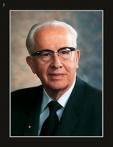
While on his mission, under Elder David O. McKay, Ezra Taft Benson helped implement the “every member a missionary” initiative. When he became president of The Church of Jesus Christ of Latter-day Saints many years later, Ezra Taft Benson applied this initiative to the whole Church and will long be remembered for it. President Benson realized that, though missionary work is very much influenced by those serving in the mission field, the most effective and important missionary work that can be done is by those who are already members of the Church living their normal lives. By being good examples and by not being afraid to share the gospel with those around them, every member can be a missionary. By referring people they come into contact with who are interested in the Church, members can help missionaries use their time much more effectively by teaching people who are already receptive to the gospel’s message.
Before he became the president of the Church, President Benson had served as the United States Secretary of Agriculture. He had studied agriculture in college and had already implemented several succesful and innovative techniques on his own farm before he was extended this appointment. His service in this department led to even more publicity for the Church and helped improve the Church Welfare Program. He also gained the respect of countless people, both within the Church and without, which made his transition into his administration a smooth one.
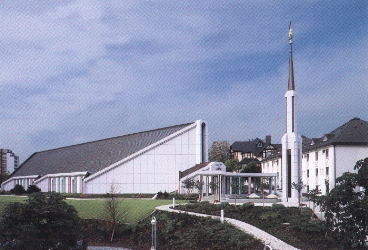
There were nine temples dedicated during President Benson’s presidency, only four of which were in the United States.
- Seoul Korea Temple
- Lima Peru Temple
- Buenos Aires Argentina Temple
- Denver Colorado Temple
- Frankfurt Germany Temple
- Portland Oregon Temple
- Las Vegas Nevada Temple
- Toronto Ontario Temple
- San Diego California Temple
President Benson strived to bring less-active members back into full activity. He also strongly encouraged all members to read the Book of Mormon daily and to give the book to non-member friends and people they came in contact with. His initiative was to flood the earth with the Book of Mormon. The year after he became president, he gave twenty-eight major talks on the Book of Mormon. He promised those who would read it that they would be blessed. He taught that the Book of Mormon is the keystone of The Church of Jesus Christ of Latter-day Saints, that it has the fulness of the gospel in it, and that individuals could get closer to God by abiding by its precepts than by any other book. He foresaw that his administration would be remembered for its emphasis on the Book of Mormon, which is still true today.
During President Benson’s admnistration, there was a push to share with the media some of the service the Church offered to those not of its faith. There was much public opinion that the Church only focused on its own members and that it was very self-centered. Using the relations already set up between departments of the Church and the media, it soon became clear that the Church was very concerned with taking care of all of God’s children who are in need. In 1986, the Church gave more than $6.5 million to organizations fighting hunger in Africa. This sum did not come from Church funds, but was the result of donations from a special church-wide fast held on January 27, 1985. In 1988, the Church donated $250,000 to provide more than one million polio immunizations for young people in Kenya and the Ivory Coast. Many Latter-day Saints helped clean up from a tropical storm in Hawaii; Hundreds of Saints volunteered to help with the winter olympics in Calgary; the list goes on and on. Several times the Church sent food, clothing, and help after major natural disasters. The people who help are organized and efficient, bringing help to those who need it most. To better organize these efforts, the Humanitarian Services Sort Center was built in Salt Lake City to provide adequate facilities for these endeavors. The complex covers an area the size of several football fields, and much of the labor performed there is acts of service from members. Service continues today both on the large and the small scale. LDS News continues to share stories of those who reach out in service to members of their community.
On January 6, 1986, President Benson met with U.S. President Ronald Reagan. They discussed world hunger and possible solutions for it. They discussed the multi-million-dollar donation the Church had made to the world hunger fund. Again, this money came from Saints who fasted and donated money for this purpose.
In addition to his many spiritual and organizational contributions to the Church, President Benson also approved the purchase of the Hotel Utah and its renovation. The hotel simply could not compete in that venue any more, so the Church remodelled the building to serve both public and private purposes. Renamed the Joseph Smith Memorial Building upon its renovation, the building now contains a chapel which can be used by the Family History Missionaries on Temple Square. Many rooms were converted into classrooms, and the Grand Ballroom was converted into a theater where the film Legacy, a film about the Saints’ trek West, showed for several years. There has since been a film called The Testaments of One Fold and One Shepherd, which is still showing. Now a film on the Prophet Joseph Smith, called Joseph Smith The Prophet of the Restoration, is also playing. Admission to the films in this building are always free and help share the message of the gospel with visitors. There are several ballrooms which can be rented for private events, and there are two restaurants in the building as well. Perhaps the most significant contribution of this building is the FamilySearch Center which is also open to the public. This center is staffed with experts in family history to help you track down ancestors and get your genealogy done.
President Benson was intimately involved with the workings of government in the U.S. and abroad. He presented many discourses on the dangers of communism, and conspiracy to destroy democracy.
Ezra Taft Benson Goes to Europe
Filed under LDS Views on War, Modern History
While stationed at Marseilles, France, I received an assignment transferring me to London. I headed to London by way of Paris. I had a few days before I had to report to London, and while in Paris, I looked up Sherm Brinton, an M.D. working in a Paris hospital, and Tom Adams who was assigned to the Provost Marshal’s office in Paris. They both held the rank of Captain and were in charge of the LDS Servicemen’s Program in the Paris area. During a church service which I attended in Paris, it was announced that Elder Ezra Taft Benson of the Council of the Twelve was coming to Paris within a day or two with the assignment to reopen the European Missions. He had obtained permission from the proper authorities to do this. In addition, he planned to bring welfare aid to the members of the Church in Europe. My orders permitted me to stay in Paris long enough to meet him. I went out to Orley Field with a group of about a dozen servicemen to greet him. One can imagine the thrill this group of young servicemen received when they met and shook hands with an apostle of the Church, especially after having been away from home for a couple of years. Many had been away for two years or more and the only contact most of us had with the Church was reading the Church News and our own experiences in attending LDS services throughout Europe when circumstances permitted.
Shortly after meeting him, he told us that he was anxious to find a serviceman who could accompany him on his tour throughout Europe. He had been told by both civilian and military authorities that it would be very difficult for a civilian to arrange travel and housing accommodations in military zones throughout Europe. He had concluded it would be best to get a serviceman to accompany him. Neither Brother Adams nor Brother Brinton could make the necessary arrangements to go with him, and it appeared that no one would be able to aid him in his mission.
Then, someone suggested that I might be able to accompany him. I thought it seemed rather unrealistic that the army would cancel my orders assigning me to London in order to accompany a civilian throughout Europe.
Nevertheless, just the thought of being in Elder Benson’s company seemed a wonderful privilege so I applied for the assignment. I went to the Chaplain Corps Headquarters in Paris and said to one of the senior chaplains, “I would like to have permission to accompany an apostle from my Church on his tour of Europe to reopen the missions for the Mormon Church.”
“Chaplain, I have never heard of any such request being granted, but we will process your application anyway. But, it seems quite unlikely that military authorities will approve your request. Come back in a couple of days.”
In a couple of days I returned, and he said, “I’m sorry, Chaplain, but there has been no word on your request.”
With some concern I said, This Church leader is most anxious to leave as soon as possible. Who can I see at headquarters who has the authority to grant me permission or turn me down.” [sic]
“Well, you might inquire at the Adjutant General’s office of Army Command. I’m sure someone over there can give you an answer.”
I went to the Adjutant General’s office and found an officer who could approve or reject my request. I was escorted into his office, and he asked, “What can I do for you, Chaplain?”
“Sir, I made out an application requesting that I accompany Elder Ezra Taft Benson of the Mormon Church on his mission throughout Europe.”
“I’m sorry, Chaplain, but I haven’t seen your application. What did you say was the name of that Church leader again?”
“Ezra Taft Benson.”
“That name strikes a familiar note. I think I have something on that man.” He pulled open his drawer and pulled out a folder. He looked through the correspondences and came to a letter. The letter came from the Chief of Staff of the Army of the United States, and it stated that Ezra Taft Benson of the Council of the Twelve of the Mormon Church would be visiting throughout Europe and stated that any assistance that might be provided by any military command would be greatly appreciated. “Well, Chaplain, it looks like Mr. Benson is some sort of V.I.P. I think that this letter is enough of an authorization to grant your request. I’ll issue your orders immediately.”
I received orders to accompany Elder Benson and his secretary, Brother Fred Babbel. In Paris, we purchased an army vehicle and Brother Babbel and I drove the vehicle into Holland where we met Brother Cornelius Zappy, president of the Netherlands Mission. This vehicle was to later prove invaluable in distributing welfare supplies from Salt Lake to needy brothers and sisters in Holland.
Our next assignment took us to Geneva, Switzerland where we met with Brother Max Zimmer, president of the Swiss-Austrian Mission. Part of Elder Benson’s assignment in Switzerland was to get permission from the Red Cross officials for the Church to send carloads of food stuffs, blankets, clothing, and other supplies from America into Europe for the Saints. In Basel, Switzerland, Elder Benson assigned President Zimmer and myself to go to Geneva, Switzerland to meet with the Red Cross leaders. We went by train to Geneva and met with the proper officials. They immediately gave the Church permission to send its welfare supplies to Church members throughout Europe.
Following Switzerland, we headed into Germany. Germany had taken a terrible beating. Many of the cities were in rubble, and few buildings stood intact. Nevertheless, we met with the Saints in all parts of Germany including Frankfurt, Dusseldorf, Stuttgart and Berlin. We soon learned that the faith of the Saints was still strong as we went from one bombed-out city to another. Our Saints met in schoolhouses that had been bombed out and other places that one would have to go through rubble to get down to an area where a little group of Saints would be gathered in some cellar of a home or meeting place. It was touching to see their faith and their love for Elder Benson and their appreciation for his visit. Often the scenes were so touching that they brought tears to the eyes of Elder Benson when he saw the destruction and conditions of the people. Many meetings were held where there was not a dry eye as members rejoiced in hearing the message and in feeling the love emanating from the Lord’s special witness at long last in their midst. We learned from many of the Saints in Europe that the aid furnished by the Church often was the difference between life and death to many members of the Church. But the most unusual thing about it was that although the Saints were grateful for the goods that were coming into Europe, their joy and appreciation were not for goods, but for the joy of having an apostle of the Church on the scene in Europe. . . .
While traveling with Elder Benson, I observed his masterful way of handling people. It was a thrilling experience to see the ease with which he moved among people whether one came from a high position or a lowly station in life. Their class or station meant no differenced to him and he put them right at ease. For example, while in Frankfurt, Germany, we visited with the commanding general of the occupation force in southern Germany. The general had a huge office with all the pomp and pageantry to go with the position. But Elder Benson was completely at ease with him, and in command of the situation. He told the general what he needed to accomplish his task and the general gave him permission to do just as he wished.
It seemed that everything he tried to do worked, and an unseen power was helping him do what was needed to complete his mission, while others were unable to accomplish the things he could do.
Chaplain Howard C. Badger, For God and Country: Memorable Stories from the Lives of Mormon Chaplains, p152–156.