Pioneers Articles
Though Mitt Romney has been getting a great deal of coverage due to his presidential campaign, a lot of the media’s focus has been on his religion rather than his politics. Not much has been said, though, about the Romney family history in Arizona, which goes back a long way.
In the 1880s, Arizona became a pivotal center of religious persecution for members of The Church of Jesus Christ of Latter-day Saints (which church is frequently misnamed the Mormon Church). The LDS Church had made efforts to colonize Arizona, sending many of its members from Utah to establish colonies along several rivers in Arizona from 1876–1881.
Things began to spiral downward for the Latter-day Saints (Mormons) in 1882, when the federal Edmunds Act was passed. This made the practice of polygamy a felony and made polygamists ineligible for public office. One local election judge refused the right to vote to at least one Mormon bishop.
Mormon polygamy is a practice which... Read the rest of this article »
The story of the Saluda is strikingly sad, especially when one takes the perspective of William Dunbar, a Scottish convert to The Church of Jesus Christ of Latter-day Saints (incorrectly referred to as the “Mormon Church” by the media). In the mid-1800s, Latter-day Saint converts were all travelling West to join the Saints in the Utah Territory. Many would arrive from Europe by ship in New Orleans, then take steamboats to St. Louis, then other steamboats up the Missouri River to Council Bluffs, Iowa (then Kanesville).
There was typically a Church representative in St. Louis to help newly arrived converts gain passage on steamboats for a fair price and get to where they needed to go. However, in 1852, the representative had left and was not replaced until the end of that year. Eli Kelsey and David J. Ross were consequently sent from Kanesville down to St. Louis to help out in the interim. They were also planning to head to the Utah Territory... Read the rest of this article »
It has always been a part of the heritage of members of The Church of Jesus Christ of Latter-day Saints (commonly called Mormons by friends of other faiths) to remember those who have gone before them, who have suffered for the sake of building up the kingdom of God. Some of the Latter-day Saint Church’s richest legacy comes from the pioneers who crossed the plains to enter the Salt Lake Valley. Some of these people came by handcart, walking thousands of miles while pulling their belongings behind them.
Two of these handcart groups struck disaster in 1856, when they left later than they should have and got stuck in horrific winter storms in Wyoming. These two groups were the Willie and Martin Handcart Companies. Many Saints died along the way, but those who survived claimed they had grown closer to God through their experience than through any other experience they had throughout their lives.
Descendants of the Saints who travelled in the Martin... Read the rest of this article »

On Saturday, October 24, 2009, a group of nearly 500 gathered at Bluff, Utah, to commemorate the journey their Mormon ancestors had made 130 years before. In 1879, the then-president of The Church of Jesus Christ of Latter-day Saints, John Taylor, called a small group of Mormon settlers to leave the homes and land they had already settled in Parowan, Utah, and to travel across the state to southeastern Utah to settle a hard area. It is a testament to the faith of these Saints that they did not blink in the face of adversity, but heeded the call of their prophet.
Bluff, Utah
It took this group of Saints six months to cross an area now known as Hole-in-the-Rock; a place so called because they literally had to cut into the rock to make a trail for their wagons down the seemingly sheer cliff. After this part of the journey they had to cross the Colorado River. Then they were met with land that their scouts told them would be impossible to cross. These Saints... Read the rest of this article »
While most Mormon pioneers travelled by foot and wagon across the United States, and later by rail when the railroad was completed, there were a few Saints who sailed from the East Coast to the West Coast of the United States. One of the most famous of these groups was the group that travelled on the Brooklyn from New York to San Francisco. The Brooklyn carried a total of 238 passengers on its voyage which departed on February 4, 1846: 70 men, 68 women, and 100 children. Most of the 238 passengers were Mormon, but a few were just general passengers.
Route of the Brooklyn
The Saints who travelled on this ship did so in response to a call from Elder Orson Pratt, who was the presiding apostle of The Church of Jesus Christ of Latter-day Saints in the eastern states, when he heard the Mormons were to leave Nauvoo, Illinois. The Saints were put under the direction of Samuel Brannon, who was the publisher of the Mormon paper The Prophet. Most of the Saints... Read the rest of this article »
Members of The Church of Jesus Christ of Latter-day Saints (also called the LDS Church or the Mormon Church) believe seeking a good education is a direct commandment from God. In Doctrine and Covenants Section 109, verse 7, it reads, “And as all have not faith, seek ye diligently and teach one another words of wisdom; yea, seek ye out of the best books words of wisdom, seek learning even by study and also by faith.” The Saints always tried to observe this commandment, but when the time came for them to head West, they felt a special need in heeding it. They were moving to an isolated wilderness and realized everything they needed in order to teach their children they would have to bring with them. In December 1847, a general epistle was issued to the Saints from Winter Quarters urging them to bring every educational thing they could with them:
“It is very desirable that all the Saints should improve every opportunity of securing at... Read the rest of this article »
After the members of The Church of Jesus Christ of Latter-day Saints had been in the Salt Lake Valley about ten years, many other people were also beginning to travel and settle in the West. Development and progress swept through the Utah Territory and the Saints began feeling pressured and threatened once again. Some felt there was much unrighteousness among the Saints which needed to be weeded out. Others felt they were already being punished for wickedness among them through such manifestations as a crop destruction in 1855. Many Saints felt there were more hardships coming and that they needed to prepare for them. All of these things were factors in the Mormon Reformation of 1856–57.
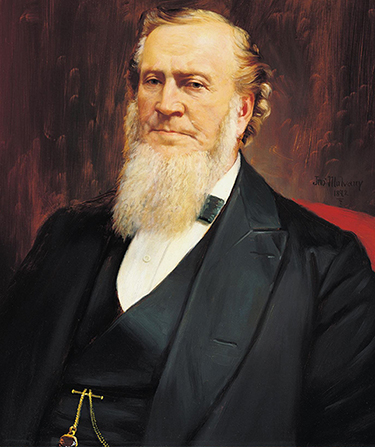
Brigham Young Mormon Prophet
Brigham Young was prophet at this time, and it seems he was mainly a factor in the reformation as a voice calling the people to repentance. Church leaders were deeply concerned about the consequences which would come unless the Saints... Read the rest of this article »
As the members of The Church of Jesus Christ of Latter-day Saints, or the Mormons, struggled to gain a foothold in their new home of the Utah Territory, it was essential that they find a way to thrive, not just to survive. Brigham Young pointed out to the Saints that the building up of the kingdom of God was a temporal as well as a spiritual commandment. He continued, “The Lord has done his share of the work. He has surrounded us with the elements containing wheat, meat, flax, wool, milk, fruit and everything with which to build up, beautify and glorify the Zion of the last days, and it is our business to mold these elements to our wants and necessities according to the knowledge we now have and the wisdom we can attain from the heavens through our faithfulness. In this way will the Lord bring Zion again upon the earth, and in no other” (Outline History of Utah and the Mormons, p159).
Mormon Planting Seed
This charge was felt keenly, and... Read the rest of this article »
When members of The Church of Jesus Christ of Latter-day Saints first arrived in the Utah territory, there were three major groups of Native Americans: the Shoshone, the Utes, and the Southern Paiute. The Utes and the Shoshones had long since acquired the horse from the Spaniards and were able to hunt. The Paiute tribes mostly gathered food and tried to grow what they could in the harsh environment.
Mormon American Indians
Feelings among all the tribes were mixed upon the arrival of the Mormons. Some wanted war, but the stronger influence was for peace. The Saints even settled in what was considered unclaimed land between the tribes, thus for some time none of the tribes felt at all encroached upon. Rather they looked to the newcomers with natural curiosity and the hope of gifts. Soon all trade with the tribes went through an agent in a designated area outside of the pioneer camp. Just three years after the Saints’ arrival an ordinance passed which... Read the rest of this article »
Upon the Saints’ arrival in the Salt Lake Valley, there was no government but what they made and enforced themselves. Even after the Mexican War had ended and Utah became a territory, it was more than twenty years before Congress provided any kind of government. The Saints’ first settlements in the Salt Lake Valley were on land that lay uncontested between two Native American tribes on the northern and southern ends of the valley: the Shoshoni and the Utes, respectively. The Mormons worked on peace with all of their Native American neighbors, and this friendship benefited both sides.
Mormon Rocky Mountains
One of the most important aspects of the pattern in which the Mormons colonized was their cooperative spirit. Based on their religious beliefs, the Mormon pioneers believed all things were of divine ownership. Brigham Young thus forbade the monopolization of land and natural resources. Those Saints who came later received the same freedoms... Read the rest of this article »