Mormon Temples Articles
Under President David O. McKay, who was president and prophet of the Mormon Church from 1951 to 1971, the Mormon Church once again concentrated itself on missionary work. Under President McKay, every worthy young man was asked to serve as a Mormon missionary, and the number of Mormon missionaries grew from a few thousand in 1951 to tens of thousands by the 1970s. This brought about a worldwide increase of membership. Many new members lived in poor regions of the world and could not easily get to the temples in Utah, New Zealand, or Europe. President McKay began plans to build more, smaller temples throughout the earth, although larger temples would continue to be built in special locations. In 1964, a second temple was built in California, in Oakland, and twin temples were built in Ogden and Provo, Utah, in 1972. The Provo Temple, located near Brigham Young University and the Missionary Training Center, has become the busiest Mormon temple. ... Read the rest of this article »
Mormon temples are designed to be a place set apart from the world, even more so than chapels. The atmosphere of the Mormon temple is to be light and peaceful, a refuge from the world and a place where the Spirit of God can have great influence. For these reasons, only Mormons who have prepared themselves through faith and repentance in Jesus Christ’s name can enter the temple. The Mormon Temple is the House of God, and a Holy Place where people learn about God and his plan for all mankind and where they participate in sacred temple ceremonies which help prepare them for eternal life.
God has revealed to modern Mormon prophets like Joseph Smith that certain ceremonies can only be performed in temples. Mormons called these sacred temple ceremonies, ordinances. Ordinances are symbolic ceremonies which teach truths about God through which a person can enter into powerful covenants with God.
Inside the Mormon temple there are primarily two ordinances... Read the rest of this article »
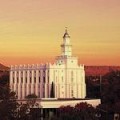
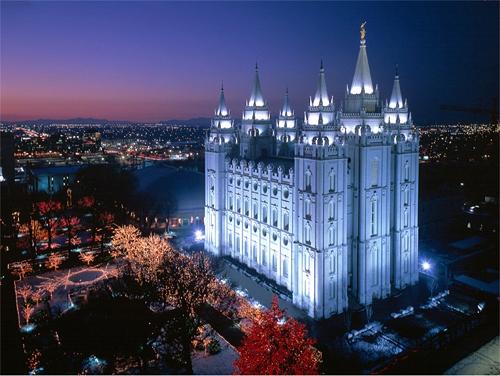
On July 24, 1847, the first body of Mormon pioneers, led by Brigham Young and the Quorum of the Twelve, reached the Salt Lake Valley. Four days later, Brigham Young marked the spot for the building of the next temple, which would serve as the center of their new city, Salt Lake City. As tens of thousands of Mormon pioneers migrated to Utah over the next few decades (nearly 80,000 by the 1870s), they continued to construct temples throughout the Rocky Mountains where they settled. The Salt Lake Temple remained a primary focus, however, even as the members worked to build up homes, cities, and the Utah territory in general. In 1855, a building called the Endowment House was erected on Temple Square, which is the block containing the Salt Lake Temple, to permit members to perform two important temple ceremonies, the endowment and celestial marriage, while the new temple was constructed. The Endowment House was torn down in the 1890s.
Meanwhile,... Read the rest of this article »
The temples of the Mormon Church are one of its most unique and distinguishing characteristics and a fruition of Mormon beliefs in the afterlife and in the purpose of our lives here on earth. Since earliest Mormon history, the prophets and members of the Mormon Church have sacrificed to build and worship in these sacred buildings. In comparison to most other Christian churches, Mormonism stands virtually alone in affirming the importance and centrality of proper authority and the use of this authority, called Priesthood, to guide Christ’s Church and build and operate Temples for the salvation of the living and the dead. In a revelation given to the Prophet Joseph Smith, the Lord Jesus Christ declared, “my people are always commanded to build [temples] unto my holy name” (Doctrine and Covenants 124:39).
Since the first Mormon temple was dedicated in 1836, 124 temples have been built, though the first two, the Kirtland Temple and the Nauvoo... Read the rest of this article »
After most of the turbulence of the nineteenth century, which witnessed much persecution against the Mormons, the Mormon Church began to grow worldwide in the twentieth century. In 1915, President Joseph F. Smith announced the construction of the Laie Hawaii Temple, the first temple outside the continental United States. The Mormon Church had great success among the peoples of the pacific Islands and especially in Hawaii. The Temple was dedicated in 1919 by President Heber J. Grant. It was the first Mormon temple not to have an assembly hall and is also unique in not having a spire. Only three Mormon Temples do not have spires, and the other two were built at this same time: The Cardston Alberta Temple and the Mesa Arizona Temple. The Cardston temple, built in an area where Mormons had fled during severe persecution in Utah in the 1880s, was the first outside of the United States. This temple also hosted the first “Temple... Read the rest of this article »
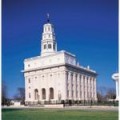
After the abortive attempts to build temples in Missouri, both in Jackson County and later in Far West, Daviess County, the Mormons built their first true temple in Nauvoo, Illinois. In late 1838, the Mormons had been forcibly expelled from Missouri by the infamous Extermination Order which decreed that all Mormons who would not flee the state would be murdered. The Latter-day Saints, as they were called, settled in Commerce, Illinois, which they renamed Nauvoo. For the Prophet Joseph Smith, building the temple was of supreme importance. He dedicated the last few years of his life to completing the temple. On May 4, 1844, less than two months before his murder, Joseph Smith said, “We need the temple more than anything else” (Journal History of the Church, May 4, 1844).
On April 6, 1841, the Mormon temple was begun at the same time as Joseph Smith began preaching the doctrine of baptism for the dead, which he had received by revelation.... Read the rest of this article »
In 1995, Gordon B. Hinckley became President and Prophet of the Mormon Church. Perhaps no person in Mormonism since Joseph Smith has had such an impact on Mormon temples and Mormon temple ceremonies. In the Mormon temple ceremony, instructional material was presented orally. After World War II, Elder Hinckley helped oversee a project to transition the presentational material onto film. Foreign language speakers could then listen on personal earphones to a synchronized translation, so this was especially useful as Church membership grew in foreign countries.
Gordon B. Hinckley has dedicated more temples than all other Mormon leaders combined. Of the 122 Mormon temples operational as of 2006, President Hinckley dedicated more than 70, or almost 60% of all Mormon Temples.
For the first couple years of President Hinckley’s tenure as prophet and president, the pace of construction continued has it had historically, with temples being being... Read the rest of this article »
As early as 1830, Joseph Smith received revelations alluding to the fact that God would require the young Mormon Church to build a temple. Even earlier, the Book of Mormon (which Joseph Smith had translated from the records of an ancient people who lived in the Americas) taught that God had commanded this people to build temples, just as God had commanded the ancient Israelites. This teaching alone, that God had commanded His people to build temples in places other than Jerusalem, was a radical departure from the standard teachings of Joseph Smith’s time.
After the Mormon Church was established on April 6, 1830, the fledgling Mormon community faced intense persecution in upper New York. Meetings were raided, baptismal services were interrupted, and members were harassed and scattered. With the membership such a scattered condition, no temple could even be considered, since the Church’s survival was constantly threatened. In late 1830,... Read the rest of this article »
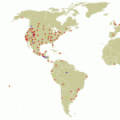
By 2006, there were 122 operating temples, with 12 more either in the planning or construction phase. President Gordon B. Hinckley said that the pace will slow from the tremendous surge seen in the late 1990s and early 2000s, but will continue until there are enough temples to dot the earth and to bless all of God’s children. Currently there are Mormon temples in dozens of countries. There are 3 Mormon temples in Africa, 6 in Asia (including Japan, Korea, Taiwan, China, and the Philippines), 10 in Australia and Oceania, 9 in Europe, and 16 in Central and South America. In North America, there are 78 Mormon temples, with 6 in Canada, and 12 in Mexico. In the United States, there are 60 Mormon temples. Twelve states–Arizona, California, Hawaii, Idaho, Illinois, Nevada, New York, Oregon, Tennessee, Texas, Utah, and Washington–have more than one. Utah has 11 temples, California has 6, Texas has 4, Washington has 3, and Arizona,... Read the rest of this article »
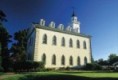
In Ohio, the Mormons were building their community in Kirtland, a small community southeast of Cleveland. May of 1833, while the Mormons in Missouri were being driven from their homes, Joseph Smith received a revelation commanding the Mormons to build a House of the Lord in Kirtland to be “dedicated unto the Lord for the work of the presidency.” The extreme poverty of the Mormons, many of whom had been driven from their lands without compensation, made this a difficult undertaking, and for a month, nothing happened. On June 1, another revelation was received chastening Joseph Smith and the Mormons for not starting the building of the new Mormon temple and promising them help in completing it. Immediately, the preparatory trenches were dug with Hyrum Smith, the Prophet’s prophet, being the first to dig. In July the cornerstones were laid and the construction continued until early 1836. Interestingly, while the Lord in His revelations referred... Read the rest of this article »