Daughters in My Kingdom, the History of Relief Society
Filed under Special Topics
The history of The Church of Jesus Christ of Latter-day Saints (often referred to as the “Mormon Church” by those of other faiths) would not be complete without recognizing the influence and support of the Relief Society and thousands of amazing women who served quietly and faithfully. This history has recently been compiled into a beautiful book called Daughters in My Kingdom: The History and Work of Relief Society. A great deal of effort went into the compilation of this book because church leaders, both male and female, felt it would be a wonderful strength for Mormon women today.
The Relief Society was organized in Nauvoo, Illinois. In 1842, the Saints were working hard to build the Nauvoo Temple, and a small group of women wanted to help in the effort. They organized to provide the men working on the temple with food, clothing, bedding, and general supplies. They organized their own set of rules and presented them to the Prophet Joseph Smith, who declared them “the best he had ever seen.” However, he saw in their plans the potential for something even greater. On March 17, 1842, twenty women gathered to participate as the Prophet organized them in a divinely inspired way. God had a plan for the women of His church.
Since that time, the Relief Society (which is one of the largest women’s organizations in the world) has helped millions of people worldwide. Many are helped in the bounds of their own congregations, but immeasurable service is also contributed every year into making hygiene kits, baby blankets, leprosy bandages, and countless other items to help victims of natural disasters, war, and poverty around the world.
Relief Society General President Julie Beck said of the divine organization:
The purpose of Relief Society is to prepare daughters of God for the blessings of eternal life as they increase in faith and personal righteousness, strengthen families and homes, and seek out and help others who are in need.
Relief Society clarifies our work and unifies us as daughters of God in defense of His plan. In this day of mistaken identities, confusion, and distraction, Relief Society is meant to be a compass and guide to teach the truth to faithful women. Righteous women today seek an outpouring of revelation to resist distractions, fight evil and spiritual destruction, and rise above personal disasters by increasing their faith, strengthening their families, and providing relief to others (“Daughters in My Kingdom: The History and Work of Relief Society,” Julie Beck, Ensign, November 2011).
Those who compiled this book have several specific goals for its use. They recognize that “a study of this book can help women increase their appreciation for the past and their understanding of their spiritual heritage” (Daughters in My Kingdom: The History and Work of Relief Society, p xii).
The stories of incredible women, their faith and commitment, and the wonderful things they have accomplished remind readers of their divine identity and the infinite worth and potential they possess as daughters of God. The book teaches through the history of Relief Society “Purposes, principles, and patterns” for women of God to practice in their lives which will bring them eternal happiness (Daughters in My Kingdom: The History and Work of Relief Society, p xiii).
One of the wonderful purposes of Relief Society is to provide a safety and a refuge for the sisters in it. Older sisters can teach younger sisters skills and spiritual truths which they have learned through experience. No woman is ever alone, no matter how close or far away her mother and family may be. Women pull together to take care of each other in times of trial and to share their joys with one another as well.
Reading experiences of so many strong, humble, faithful women will be a wonderful opportunity for women everywhere. It will bring strength into the lives of those who read it whether they have a connection with The Church of Jesus Christ of Latter-day Saints or not.
Additional Resources:
Stories from Latter-day Saint Women
The Book of Mormon and Other Mormon Scripture
Filed under Mormon Beliefs
The Church of Jesus Christ of Latter-day Saints, which is commonly nicknamed the “Mormon Church” by those of other faiths, has a large canon of scripture. Whereas most Christian religions only accept the Bible as the word of God, the LDS Church has four canonized books of scripture: the Bible (King James Version), the Book of Mormon (a book of scripture about Jesus Christ’s dealings with some of the inhabitants of ancient America), the Doctrine and Covenants (a collection of modern-day scripture, most of which was revealed to the Prophet Joseph Smith), and the Pearl of Great Price (a modern collection of ancient scripture).
The Bible
Latter-day Saints believe the Bible to be the word of God, as far as it is translated correctly. This means that Latter-day Saints believe it once contained the fulness of the gospel of Jesus Christ, but over time many of these simple and precious truths were lost. Some were lost through the transmission and translation of ancient documents. Others were lost because designing men did not like what they found in it and deleted many things.
The Book of Mormon
Mormon doctrine teaches that God foresaw that many things would be lost from the Bible, so he prepared another record containing the fulness of the gospel and preserved it to come forth in the latter days. This book of scripture is now known as the Book of Mormon and is a record which ancient inhabitants of the Americas kept of Christ’s dealings with them. In the early 1800s, God the Father and His Son, Jesus Christ, appeared to a boy named Joseph Smith and revealed many of these things to him, calling him to be a prophet and to restore the truth to the earth. An angel named Moroni, he who had buried the record as one of the last acts of his life, led Joseph Smith to its hiding place. Joseph Smith then translated the text through the power of God.
The Book of Mormon is another testament that Jesus is the Christ and is meant to be a companion text to the Bible. It reinforced and clarifies many doctrines which are already present in the Bible.
The Doctrine and Covenants
Latter-day Saints believe that God still speaks to His children today. When Joseph Smith was called to restore the church of Jesus Christ in its fulness, he constantly sought the Lord’s help through prayer. He received answers to his questions through revelations. Many of these revelations are recorded in the Doctrine and Covenants, and they reveal God’s will about His people in our day.
The Pearl of Great Price
Joseph Smith undertook a translation of the Bible through the power of the Holy Ghost, under direction from God. In reading parts of the Bible, he was inspired to write things which had been lost from the original text. Many of these things are recorded in the Pearl of Great Price. In addition, an ancient papyrus scroll came into the hands of the early Saints which was a record of Abraham from his time in Egypt. This was also translated by Joseph Smith and is published in the Pearl of Great Price.
Open Canon
In addition to these four books of scripture, Latter-day Saints believe that God continues to speak through his prophet today. Church leaders called General Authorities are also considered to speak the word of God in their callings. All these sacred words are considered to be scripture as well, and are treated as such.
Additional Resources:
How Does the Book of Mormon Relate to My Bible Study?
Learn More about the Book of Mormon
What Is Unique about the Book of Mormon?
Mitt Romney and Tithing
Filed under Uncategorized
The years of 2011–2012 are being called by many in the media the “Mormon moment.” It is truly a unique time in Mormon history. Two Mormon candidates for the Presidency of the United States of America have brought a great deal of discussion to the forefront. Many other things have contributed to the discussion, such as the Book of Mormon musical on Broadway and shows on reality television claiming to depict Mormon polygamists who are really fundamentalists. Much of this discussion has been good. Though many misconceptions still exist about The Church of Jesus Christ of Latter-day Saints, as the nicknamed “Mormon Church” is officially called, the discussion has begun to show some of the truth about what Latter-day Saints believe.
A lot of attention has been given to presidential-candidate Mitt Romney’s recent publication of his taxes. Romney has been the center of much attention and discussion as a Mormon candidate for president. One misconception that exists among the general public about the LDS Church is the principle of tithing. Tithing in The Church of Jesus Christ of Latter-day Saints differs in a few key ways from the principle in other Christian churches.
All members of The Church of Jesus Christ of Latter-day Saints are commanded to pay a tithe, which the Lord has designated as one-tenth of a person’s annual income. Unlike many other churches whose clergy is professional, the “Mormon Church” has a lay clergy. This means that all those who hold any type of leadership position give of their time and service voluntarily and without monetary compensation. This holds true even for the highest leadership of The Church of Jesus Christ of Latter-day Saints. Individuals who serve in the LDS Church support themselves financially on their own.
Though the commandment to pay tithing is referenced in the Old Testament, modern scripture also reveals that Saints today should be faithful in paying their tithing. The Doctrine and Covenants, which is considered by Latter-day Saints to be a record of modern scripture, says the following: ”Those who have thus been tithed shall pay one-tenth of all their interest annually; and this shall be a standing law unto them forever, for my holy priesthood, saith the Lord” (D&C 119:4).
Funds from tithing are used to build up the Lord’s kingdom on the earth. They are used to erect meetinghouses and temples and to provide for the poor as needed. The procedures for dispensing of the tithes which are collected are standardized around the world and are very strict. The First Presidency, the Quorum of the Twelve Apostles, and the Presiding Bishopric comprise the Council on the Disposition of Tithes. These men meet together to allot tithing money to different areas of the church. They do so in prayer and solemnity. The tithing funds are viewed as sacred. They are the Lord’s. Thus, any who are involved in spending it view the responsibility as a very serious one. They truly desire to know God’s will in how the money should be wisely spent. The Church of Jesus Christ of Latter-day Saints accrues no debt. No building is begun unless all the funds are already present to pay for it.
The Church of Jesus Christ of Latter-day Saints continues to be financially successful because financial control is based upon budgeting, organizational structure, sound judgment and investments, and frequent complete audits. The audit committee is made up of disinterested, experienced businessmen who are not connected to the Church in any other way. Church leaders are scrupulous in ensuring only ethical practices and procedures are used for Church funds.
Though tithing is viewed as a commandment, it is still voluntary. It is also kept confidential. No one but the individual, the bishop and his clerk know how much a person pays in tithing. Once a year, individuals have the opportunity to meet with the bishop and to declare if they are a full-tithe payer or a non-full-tithe payer. No records are checked against pay stubs. It is all on the honor system.
In addition to paying tithing, members of The Church of Jesus Christ of Latter-day Saints have the opportunity to contribute to many other Church funds. Some of these include the missionary fund (which provides financial help for individuals who wish to serve a mission but cannot afford to support themselves entirely), the Book of Mormon fund (which allows copies of the Book of Mormon to be distributed for free to interested parties), the Humanitarian Aid Fund (which helps victims of natural disasters and war worldwide, regardless of religious affiliation), and the Perpetual Education Fund (which gives small loans to church members allowing them to gain a technical education; upon graduation and employment, they pay back the loan without interest, allowing others to benefit from the program).
Mitt Romney’s current tax records show that 15 percent of his income was contributed to charitable causes. While 10 percent of this is likely his tithing, the extra 5 percent could be split up in myriad ways through the Church’s other funds or through charitable foundations not connected with the Church at all.
Mitt Romney’s Mormon donations, as well as donations from millions of other members, allow The Church of Jesus Christ of Latter-day Saints to continue doing the Lord’s work throughout the world. None of these funds benefit individuals. They are all used for the building up of the Kingdom of God.
Additional Resources:
Mitt Romney’s Mormon Donations
The Power of Healing
Filed under Mormon Beliefs
“And Jesus went about all Galilee, teaching in their synagogues, and preaching the gospel of the kingdom, and healing all manner of sickness and all manner of disease among the people…and they brought unto him all sick people that were taken with divers diseases and torments, and those which were possessed with devils, and those which were lunatick, and those that had the palsy; and he healed them” (Matthew 4:23).
As the New Testament clearly illustrates with story after story of miraculous healing for diverse diseases and afflictions, the power to heal is a clear sign of the true church of Jesus Christ. This power to heal was only given to those whom Jesus Christ had called and given the priesthood power. Sadly, the priesthood was lost from the earth when all the apostles were killed, due to the wickedness of men in ancient times. However, the fulness of the gospel of Jesus Christ was restored through a man called of God in our day, Joseph Smith.
The priesthood power was restored to the earth by those who had last held it: John the Baptist restored the Aaronic (or lesser) Priesthood to Joseph Smith and Oliver Cowdery, and Peter, James, and John restored teh Melchizedek (or higher) Priesthood to the same to men a few days later. The Church of Jesus Christ of Latter-day Saints (commonly misnamed the Mormon Church) believes in this priesthood power. All worthy male members of the church are able to receive the keys of the priesthood, though they are only able to use it to serve others and the Lord.
One of the great blessings of the priesthood is the power of healing. There are countless instances in the history of The Church of Jesus Christ of Latter-day Saints where its members (and sometimes those who are not members) have been served by worthy holders of the priesthood and have been miraculously healed through the power of God. The major limiting factor to this power is that it cannot be used contrary to the will of God. A sick person may have faith that Jesus is the Christ and that He has the power to heal them (a requirement for any priesthood blessing), but if it is not God’s will for an individual to be healed, that person will not be healed.
On the other hand, when it is God’s will, miracles truly happen. Following are some personal experiences people have had with the power of healing.
Elder Matthew Cowley related the following healing incident:
I was down on the Indian reservation when I met a sister who had just joined the Church, a beautiful Navajo woman…After I had met this sister, one of the missionaries called me off to the side and said, “A few months ago my companion and I went into a hogan and that lady, that Indian sister, was lying on the ground on a sheepskin. She had been lying there for six long years. We called on her, and when we were leaving she called us back and said in broken English, ‘Isn’t there something you do for sick people?’ And we said, ‘Yes.’ She said, ‘Please do it for me.’ So they got down on their knees and administered to her, by the authority of the priesthood and in the name of Jesus Christ. Then they left, and they weren’t away fifty yards when she came out of the hogan after them and said, ‘Come back and see what you have done for me.’ She walked (Matthew Cowley, BYU Speeches of the Year: April 5, 1966).
Another miraculous and well-documented experience from the early days of The Church of Jesus Christ of Latter-day Saints. After the Saints were driven from Missouri, they were living in camp-like conditions in Illinois when a choelra epidemic swept through their numbers. Wilford Woodruff shared the following experience:
On the morning of the 22nd of July, 1839, [the Prophet] arose reflecting upon the situation of the Saints of God in their persecutions and afflictions. He called upon the Lord in prayer, and the power of God rested mightily upon him. And as Jesus healed all the sick around Him in His day, so Joseph, the Prophet of God, healed all around on this occasion. He healed all in his house and dooryard, then, in company with Sidney Rigdon and several of the Twelve, he went through among the sick lying on the bank of the river, and he commanded them in a loud voice, in the name of Jesus Christ, to come up and be made whole, and they were all healed.
When he healed all that were sick on the east side of the river, they crossed the Mississippi River to Montrose, where we were. The first house they went into was President Brigham Young‘s. He was sick on his bed at the time. The Prophet went into his house and healed him, and they all came out together. As they were passing by my door, Brother Joseph said, “Brother Woodruff, follow me.”
These were the only words spoken by any of the company from the time they left Brother Brigham’s house till we crossed the public square and entered Brother Elijah Fordham’s house. Brother Fordham had been dying for an hour, and we expected each minute would be his last.
I felt the power of God that was overwhelming His prophet. When we entered the house, Brother Joseph walked up to Brother Fordham and took him by the right hand; in his left hand he held his hat.
He saw that Brother Fordham’s eyes were glazed, and that he was speechless and unconscious.
After taking hold of his hand, the Prophet looked down into the dying man’s face and said, “Brother Fordham, do you not know me?”
At first he made no reply; but we could all see the effect of the Spirit of God resting upon him.
Joseph again said, “Elijah, do you not know me?”
With a low whisper, Brother Fordham answered, “Yes.”
The Prophet then said, “Have you not faith to be healed?”
The answer, which was a little plainer than before, was, “I am afraid it is too late. If you had come sooner, I think I might have been.”
He had the appearance of a man waking from sleep. It was the sleep of death.
Joseph then said, “Do you believe that Jesus is the Christ?”
“I do, Brother Joseph,” was the response.
Then the Prophet of God spoke with a loud voice, as in the majesty of the Godhead, “Elijah, I command you, in the name of Jesus of Nazareth, to arise and be made whole!”
The words of the Prophet were not like the words of man, but like the voice of God. It seemed to me that the house shook from its foundation. Elijah Fordham leaped from his bed like a man raised from the dead. A healthy color came to his face, and life was manifested in every act. His feet were done up in Indian-meal poultices. He kicked them off his feet, scattered the contents, then called for his clothes and put them on. He asked for a bowl of bread and milk and ate it. Then he put on his hat and followed us into the street to visit others who were sick.
As soon as we left Brother Fordham’s house, we went into the house of Joseph B. Noble, who was very low and dangerously sick. When we entered the house, Brother Joseph took him by the hand, and commanded him, in the name of Jesus Christ, to arise and be made whole. He did arise and was immediately healed.
While this was going on, the wicked mob in the place, led by one Kilburn, had become alarmed, and followed us into Brother Noble’s house. Before they arrived there, Brother Joseph had called upon Brother Fordham to offer prayer. While he was praying, the mob entered, with all the evil spirits accompanying them. As soon as they entered, Brother Fordham, who was praying, fainted and sank to the floor.
When Joseph saw the mob in the house, he arose and had the room cleared of both that class of men and their attendant devils. Then Brother Fordham immediately revived and finished his prayer.
This shows what power evil spirits have upon the tabernacles of men. The Saints are only saved from the devil by the power of God.
This case of Brother Noble’s was the last one of healing upon that day. It was the greatest day for the manifestation of the power of God through the gift of healing since the organization of the Church.
When we left Brother Noble, the Prophet Joseph went with those who accompanied him from the other side of the bank of the river, to return home. While waiting for the ferryboat, a man of the world, knowing of the miracles which had been performed, came to him and asked him if he would not go and heal his twin children, about five months old, who were both lying sick nigh unto death. They were some two miles from Montrose.
The Prophet said he could not go, but after pausing some time, he said he would send some one to heal them. He then turned to me and said, “You go with the man and heal his children.”…I went with the man, and did as the Prophet commanded me, and the children were healed (Hyrum L. Andrus and Helen Mae Andrus, They Knew the Prophet, p. 82–84).
Faithful members of The Church of Jesus Christ of Latter-day Saints know that there is true power in the priesthood and that the power of healing is real.
Read a full article on this topic.
Pioneer Descendants Remember Mormon Ancestors
Filed under Church History Sites, Pioneers
It has always been a part of the heritage of members of The Church of Jesus Christ of Latter-day Saints (commonly called Mormons by friends of other faiths) to remember those who have gone before them, who have suffered for the sake of building up the kingdom of God. Some of the Latter-day Saint Church’s richest legacy comes from the pioneers who crossed the plains to enter the Salt Lake Valley. Some of these people came by handcart, walking thousands of miles while pulling their belongings behind them.
Two of these handcart groups struck disaster in 1856, when they left later than they should have and got stuck in horrific winter storms in Wyoming. These two groups were the Willie and Martin Handcart Companies. Many Saints died along the way, but those who survived claimed they had grown closer to God through their experience than through any other experience they had throughout their lives.
Descendants of the Saints who travelled in the Martin Handcart Company came together in the summer of 2011 to make some of the difficult part of the trek in memory of their ancestors. It is not uncommon for members of the Mormon Church (as The Church of Jesus Christ of Latter-day Saints is often mistakenly referred to) to particpate in treks commemorating those who have gone before. However, this particular trek was the first that was solely made up of descendants of this company.
The Martin’s Cove Historic site in Wyoming is owned and operated by The Church of Jesus Christ of Latter-day Saints and is 933 acres. It is located 55 miles southwest of Casper, Wyoming. This is where 160 descendants of the Martin Handcart Company gathered in 2011 to commemorate their anscestors’ trek. Particpants ranged in age from babies to grandparents. They pulled handcarts (in pioneer dress), square-danced, played pioneer games, and listened to stories of what their ancestors suffered, sacrificed, and rose above, through the power of God.
Leta Greene, one of the older participants, was able to do far more than she thought she would. Being wheelchair bound, she didn’t think she would be able to participate, but her children were able to pull her in her own handcart of sorts, so she was able to participate.
The trekkers were also able to cross the Sweetwater River, which their ancestors had had to cross in the middle of winter. The cold water took the lives of some of the original company, but crossing in the summer, trekkers were still able to feel a kinship with their ancestors.
People are already planning another similar reunion for descendants of the Willie Handcart Company descendants. Mormons know how important their ancestors’ sacrifices were to building up the kingdom of God. Sacrifices others have made, even if they were not direct ancestors of current members of The Church of Jesus Christ of Latter-day Saints, have helped make the Church stronger and have provided an environment of less persecution for those who practice Mormonism.
Jewish Colony in Clarion, Utah
Filed under Special Topics
In the early 1900s, a small, international back-to-the-soil movement of Jews affected a remote area in central Utah, and Clarion came into being. The Zionist movement was creating small communities in Israel where Jews could return and live. The idea spread and 40 such colonies were created in the United States of America, while a handful of others were founded in Canada and Argentina.
Utah Governor Spry encouraged Jews to come to Utah and participate in the venture to settle Clarion and to create their own community. One hundred fifty people, from both New York City and Philadelphia answered the call. These were mostly people from East Coast ghettos who were seeking a return to their roots and a better way of life. Backed by several wealthy Salt Lake City Jews, as well as others, the project purchased 6,000 acres in central Utah and $150,000 bond was underwritten for the participants.
Of the 150 Jews to come to Clarion, only one listed his occupation as “farmer.” All these Jews were of Russian or Polish descent and were between 20 and 30 years of age. Most of them had been in the United States fewer than five years. They had almost no experience in farming or with the trials they went through. They sacrificed a great deal for the prospect of something better.
A small advance party consisting of just 12 members arrived in the fall of 1911, headed by Benjamin Brown. They cleared land, plowed, and began to plant. They succeeded in cultivating 1,500 acres that year. The next year the settlement’s population had grown to 23 families. After the colony’s first harvest, Governor Spry travelled there to speak at the celebration attended by more than 1,000 people.
The hopes of the settlers were high. They felt that if they were willing to work hard enough, they could accomplish anything. However, irrigation farming proved extremely difficult for the inexperienced settlers and the water supply was unreliable. the first year’s crop was not big enough for the settlers to make their loan payment. Despite the situation getting worse, people continued to arrive.
To sustain the colony, the settlers had to depend on the good will of others. People continued to invest and try and aid the settlers, but after four years, Clarion was still not even breaking even. In the late fall of 1915, the State Land Board foreclosed on the land, and the majority of Clarion residents had to leave. A combination of factors, including lack of success with irrigation, an early frost, broken equipment, bad weather, financial troubles, and poor soil yielding poor crops contributed to Clarion’s failure. Many of the settlers left in frustration and despair.
Upon leaving Utah, the settlers went myriad ways; many returned to New York and Philadelphia, some left to farm in California, Michigan, and Pennsylvania, a few even stayed in Utah. By 1920, however, even those who stayed behind originally felt compelled to leave. Some documents suggest that they were afraid their children would marry outside of their faith, due to the lack of a Jewish population.
One historian, Robert A. Goldberg, said of the experiment: “Clarion died an early death. The site chosen was characterized by marginal soil and an undependable water system. Moreover, the colonists’ knowledge of farming as well as their funds were inadequate to sustain their effort. Yet, they had looked beyond personal self-interest and fought for a Jewish rebirth on the land and an end to bigotry. That they failed is their history; that they dreamed and struggled and were greater than themselves is their legacy.”
The failure of this Jewish community to succeed is even more understandable when one learns that even today much of the land they were attempting to farm has been found unsuitable for irrigation. Only about half of the original 6,000 acres are farmed today.
A particular event captures perfectly the whole experience. A large cistern was built early on, whose purpose it was to filter and store culinary water. The first time the cistern was filled, however, it collapsed. Later inspection shows it had inadequate internal support because there was no re-bar in the concrete.
A small group of Scandinavian Mormons moved into the area after the Jews left, but they disbanded in 1934 due to lack of water. The Jews who attempted to settle Clarion certainly did not lack will or effort, though they did lack experience. However, there was just simply not enough water to make the area viable for farming.
The remains of the cistern and a few gravestones written on in both English and Hebrew are all that remain of Clarion today, except the legacy these brave Jews leave of determination and hope.
References:
“A Short History of Clarion” by Roger D. Hansen; http://www.waterhistory.org/histories/clarion/
“Remnants of Jewish immigrant colony in Utah show experiment gone awry” by Jessica Ravitz; http://www.sltrib.com/Faith/ci_11095676
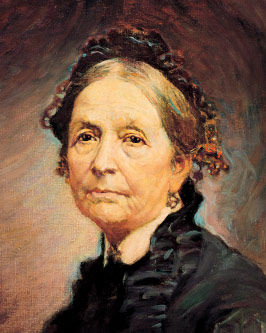
Mary Fielding Smith
Filed under Personal Accounts
Though this is not a personal account of Mary Fielding Smith, it is a testament to her enduring faith. She went West with the Saints after her husband, Hyrum Smith, had been martyred at Carthage Jail with his brother Joseph Smith. This is part of her story:
Mary Fielding Smith, a faithful Latter-day Saint woman, was left with several young children while her husband was in Liberty Jail during the winter of 1838–39. Mobs raided her home, and her son was nearly killed as a result of the attack. As the wife of Hyrum Smith, Mary was left a widow when her husband was assassinated at Carthage Jail on June 27, 1844. She and Emma Smith endured many trials along with their husbands, Hyrum and Joseph Smith. Today, Mary is admired as one of the most stalwart pioneers of the early Church.
Mary married Hyrum Smith on December 24, 1837. Hyrum’s first wife, Jerusha, had died in childbirth, and Mary cared for Hyrum’s small children as her own. Hyrum and Mary also had two children together, including Joseph F. Smith, who later became the sixth President of the Church.
When the Saints left Nauvoo for the Salt Lake Valley after Joseph and Hyrum were martyred, Mary resolved to make the journey. She and her family were assigned to a traveling group, and the captain told her that she would be a burden to others and shouldn’t attempt the difficult journey. Mary responded, “I will beat you to the valley and will ask no help from you either.” The trek proved difficult, but she arrived with her family in Salt Lake on September 23, 1848, a day ahead of the captain who had doubted her.
Mary Fielding Smith remained faithful to the end of her life. She paid tithing, even in her poverty. When someone inappropriately suggested she not contribute a tenth of the potatoes she had grown that year, she responded, “You ought to be ashamed of yourself. Would you deny me a blessing? … I pay my tithing, not only because it is a law of God, but because I expect a blessing by doing it.” She established a farm in the Salt Lake Valley and taught her children the gospel. President Joseph F. Smith later said, “She taught me honor, and virtue, and truth, and integrity to the kingdom of God, and she taught me not only by precept but by example.”
Originally published in Ensign July 2011.
The Mormon
Filed under Modern History of the Church, Special Topics
The Mormon religion has been growing substantially since its organization on April 6, 1830, in New York. In the last 180 years, its membership has grown to 14,131,467. The Church of Jesus Christ of Latter-day Saints, as the Mormon Church is officially known, now has more members outside of the United States than inside it, making it a truly worldwide religion.
The Mormon people are known for being happy and for serving others. They are taught to seek out the virtuous things of the world (Article of Faith 13) and to obey the laws of the land in which they live. The Mormon temples which now dot the earth now number more than 130. These beautiful buildings continue to capture the attention of the communities in which they are built. Each temple has an open house period of two to three weeks, before its dedication, in which members of the public are invited to walk through the building and to ask questions about the Mormon religion as well as Mormon temples. These increasing opportunities are helping to dispel a lot of persisting misconceptions and prejudices about the frequently misunderstood religion.
Latter-day Saints (as the Mormons prefer to be called) are encouraged to build up their communities wherever they are. Work is an eternal principle of Mormon doctrine, and idleness is viewed as a vice. Self-reliance is an aspect of Mormon welfare, with the motto of doing all we can to “help people help themselves.”
There are many famous Mormons in society today, including Gladys Knight, Mitt Romney, Alan Ashton (former WordPerfect CEO), Dale Murphy (Atlanta Braves Hall of Famer), Danny Ainge, Ty Detmer, and many others. Often when people not of the Mormon faith hear names like this, they are surprised because they consider the Mormon religion more of a cult. There is nothing cultish about Mormonism, however. Mormons worship Jesus Christ as their Savior, as all other believing Christians do. Mormons simply have the fulness of the truth, and wish to add the joy of that truth to what other people already have.
Black Mormon
Filed under Mormon Beliefs
The history of Blacks and The Church of Jesus Christ of Latter-day Saints (also known as the Mormon Church) is at some times difficult to discern, but is much more favorable than the history of Blacks and the United States of America. While many people in the world today continue to criticize the Mormon Church for its history with Blacks, particularly African Americans, today Black Mormons enjoy all the same privileges that Mormons of any other race or ethnicity enjoy.
In the early days of the Mormon Church, there was no policy regarding Blacks. There were certainly a few free African Americans who joined the Mormon Church and who were given equal status to any other member. The first Black Mormon was a man named Elijah Abel. He was baptized in 1832 and was ordained to the priesthood. As far as records show, it was most likely Joseph Smith who ordained Elijah Abel to the priesthood. Elijah served multiple missions for the Church and was educated and had his own profession as a carpenter. He also functioned as a seventy in Church leadership. A handful of other Black males also received the priesthood in the early days of the Mormon Church. However, at some point, Black Mormons, though they could still be baptized members of The Church of Jesus Christ of Latter-day Saints, were no longer ordained to the priesthood and were not given the opportunity to participate in the Mormon endowment ceremony. People both in- and outside of the Mormon Church have spent years debating why this was so, but there is no clear answer to that question at this time. While there was no official ban holding Blacks from the priesthood, there was also no clear commandment it be given to them. Many speculate that due to the racial prejudices which raged across the United States at this time, that it was the Latter-day Saints themselves who were not ready to accept Blacks fully into the Church, but there is no way to know if this was why the priesthood was withheld or not without direct answers from the Lord.
The resolution to this time in the history of the Mormon Church and with Black Mormons occurred in 1978, when President Spencer W. Kimball sought and received specific revelation from God regarding this matter. From this time forward, all worthy male members of the Mormon Church would be given the priesthood, regardless of race. This was a joyous day for all members of the Church, that full fellowship and blessings were granted to everyone.
There are a few things to be said about the rest of the Mormon Church’s history with Black Mormons. The Church of Jesus Christ of Latter-day Saints has always been anti-slavery, and indeed a great deal of the persecution aimed at them in the 1800s was due to their views on slavery. An editorial entitled “Free People of Color” was printed by W. W. Phelps in 1833 in Missouri, warning Black Mormons to not cross the state line due to laws which said even free Blacks could be whipped for entering the state. After quoting the law on this subject, Phelps warned Church members, “Slaves are real estate in this and other states, and wisdom would dictate great care among the branches of the Church of Christ on this subject. So long as we have no special rule in the Church, as to people of color, let prudence guide.” This statement is clear that there were no policies in place regarding Black Mormons at this time; they were treated the same as any others. Phelps recognized the volatile situation in Missouri regarding Blacks at this time, however, and warned all the Saints to exercise caution in this matter. Unfortunately, the general public took the article in exactly the opposite way, willfully misinterpreted it, and used it as fuel to add to the fire which led to an extermination order against the Saints in Missouri. The citizens of Missouri were so worried that enough Mormons would come to the state that they would get the majority vote to abolish slavery. In response, they physically forced the Saints from their homes and drove them out of the state.
The Church of Jesus Christ of Latter-day Saints has never had segregated congregations. All meetings have always been open to all who wished to attend, regardless of gender or race. Mormon doctrine is clear that God is no respecter of persons, and that the blessings of the gospel of Jesus Christ are available to all those who are worthy and who live His commandments.
Dawn Schmith’s Conversion, Great-Great-Great Granddaughter of Joseph Smith
Many descendants of Joseph and Emma Smith have been unaware of the significance of their ancestry for a good part of their lives. Dawn Schmith is a third-great granddaughter of Joseph and Emma who recently joined The Church of Jesus Christ of Latter-day Saints, the church that Joseph organized and gave his life as a testimony of its truthfulness.
Dawn Schmith was born and raised in Newcastle, New South Wales, Australia to religious parents. Though her paternal grandmother was the granddaughter of Joseph Smith, Jr., by his son Alexander Hale Smith, Dawn was raised in the Catholic faith. She actively participated in the religion her whole life and raised her two daughters in the faith. The first time Dawn heard about her ancestry was when she was 12 years old, but it was not discussed. Immediately, she wanted to learn more, but her paternal grandmother died around the same time, and she was never able to ask her any questions regarding that history.
Dawn had experiences with the LDS missionaries, but remained active in her Catholic faith. As her curiosity and desire to know more about her family history increased, she contacted LDS genealogist Janet Reakes, who put Dawn in touch with the Smith family organization in America. The organization sent Dawn a large book full of her ancestry, which she was thrilled to have. It was the first written information she had about her family history. Though Dawn’s father was upset at her contacting the Smith family organization, Dawn continued to meet with other Smith family descendants, including Gracia Jonesand her husband, who came to visit her in Hervey Bay, Australia.
Finally, in 2005, Dawn and her cousin Vicki attended a family reunion in Sydney celebrating Joseph Smith’s 200th birthday. Their intent was to correct an oversight in a family book which had omitted their grandmother’s name. They both enjoyed their interactions with the people of the LDS faith, and Dawn kept in touch with two senior missionaries, and thus kept in contact with the LDS Church.
Two years later, Dawn had a great desire to go to the United States, to Nauvoo, Illinois, for a larger Smith family reunion, but she could not scrape enough money together to cover the costs. She told her cousin Gracia she couldn’t afford to come, but other relatives generously covered the cost for Dawn to make the trip. This was Dawn’s first trip out of Australia, and it really changed her life. She learned so much about her family, and when she returned home, she began attending The Church of Jesus Christ of Latter-day Saints.
Dawn was baptized soon thereafter; a choice which was not without sacrifice. Dawn had been a Eucharistic Minister in the Catholic Church and was very dedicated to her faith. Though it caused some controversy in her family, Dawn stated her excitement about the LDS Church was greater than any she had felt in her life for a long time.
Before her baptism, Dawn had already decided to live the Word of Wisdom, or the Mormon health law. She had not consumed alcohol for more than 25 years previous to her baptism and had not smoked tobacco for 22 years. She also gave up coffee and tea. In giving up the use of these harmful and addictive substances, she gained a personal testimony of Joseph’s prophetic insight into the effects of these things.
Dawn said: “I believe Joseph is a true Prophet of God, I believe he was given messages from God and that he translated the Book of Mormon from the gold plates. I believe Emma is one of the pioneers of America and Christian fellowship. The life she lived was hard with losing children, pulling up stumps and having to go further and further away from her parents. She had no family support from her side of the family. She gave so much up to follow Joseph and help him in his mission. The saying goes, ‘Behind every great man is a great woman,’ I believe she is the great woman.”
One of Dawn’s daughters, Kim, was also recently baptized. Dawn and her daughter are now both looking forward to attending the Mormon temple.
This story taken from “Missionary Moment: Third great-granddaughter of Joseph and Emma Smith Joins Church“, Meridian Magazine, June 16, 2011.